
Module 04
Neuroscience, Trauma, and the Body
Learn the importance of embodiment facilitation and be able to support all participants in reconnecting with their bodies, nervous systems, for group regulation and safety.
Community Relational Training
Somatics, Physiology, and Energetics
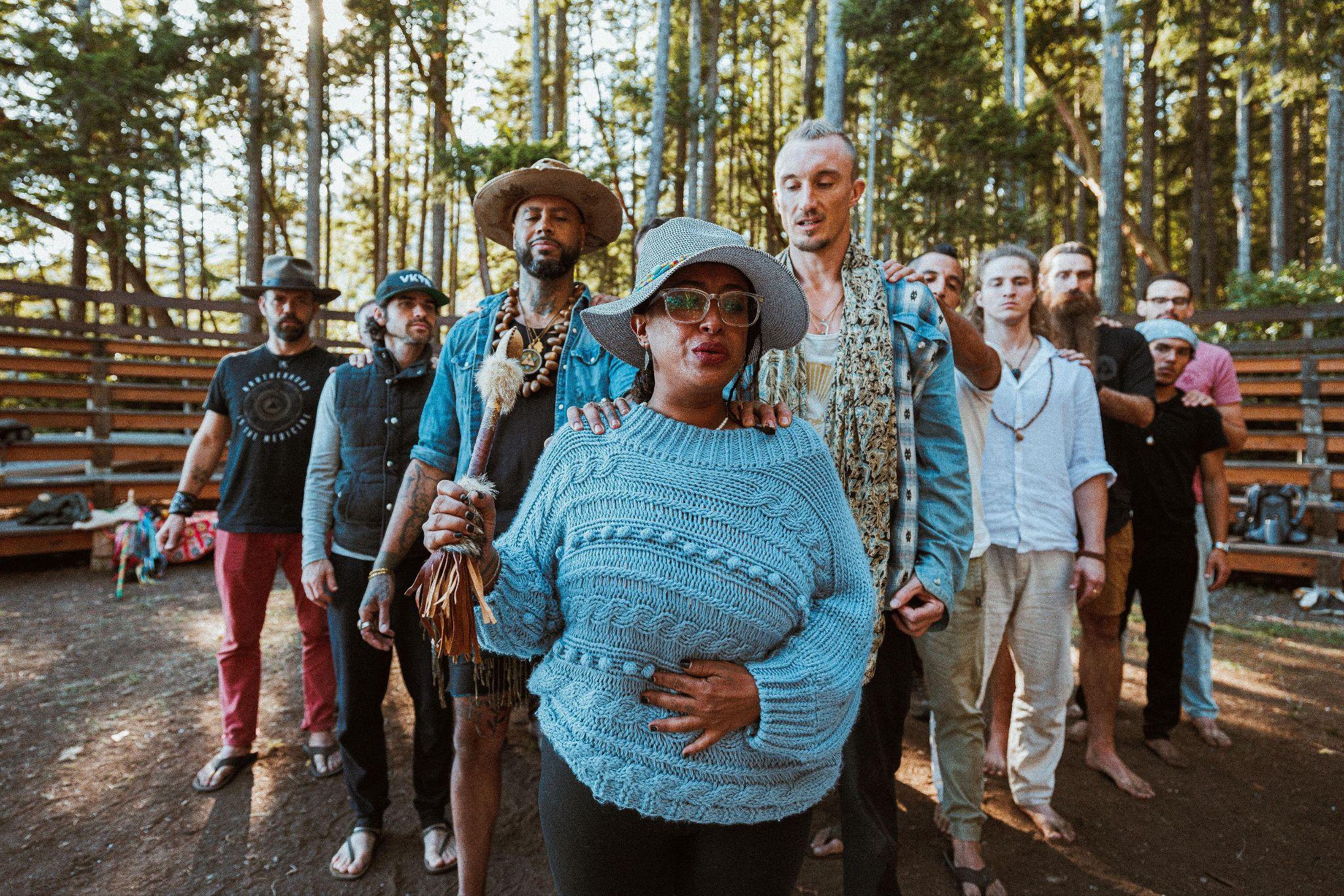
Healing is not only a psychological process—it is a physiological and relational one. Human beings experience life through the body, and the body carries the imprint of personal experiences, relational dynamics, cultural histories, and environmental conditions. Stress, trauma, and emotional experiences are not stored only as memories or narratives; they are held within the nervous system, muscular patterns, breath, hormonal systems, and energetic responses of the body. When people gather in community spaces to share truth, process emotions, or repair relationships, their bodies and nervous systems are continuously responding to cues of safety, belonging, threat, and connection.
Somatically—meaning “in the body”—men and women often process trauma and healing differently due to a complex interplay of biology, hormones, social conditioning, and nervous system imprinting. Somatics is a field of bodywork and movement studies focusing on internal physical perception and the "soma"—the body experienced from within. Coined by Thomas Hanna, it uses slow, conscious movements to retrain nervous system patterns, relieve chronic pain, and release stored tension or trauma, rather than focusing on external, aesthetic performance. Somatics uses the mind-body connection to help you survey your internal self and listen to signals from your body on pain, discomfort, or imbalance. Somatics is the study of the lived and felt experience of the body—offers insight into how physiological states influence behavior, emotional regulation, and relational capacity.
Facilitators who understand these physiological processes are better equipped to guide participants towards co-regulation, presence, and relational repatterning, especially during emotionally charged conversations or moments of tension. Neuroscience and trauma research demonstrate that when individuals feel safe and supported, the nervous system shifts into states that support reflection, empathy, cooperation, and healing. When safety is absent, the body may move into survival responses such as fight, flight, freeze, fawn or collapse.
This chapter introduces facilitators to the foundational principles of somatics, nervous system regulation, and energetic awareness, offering practical tools for holding spaces that support ethical, trauma-informed, and relationally grounded group processes.
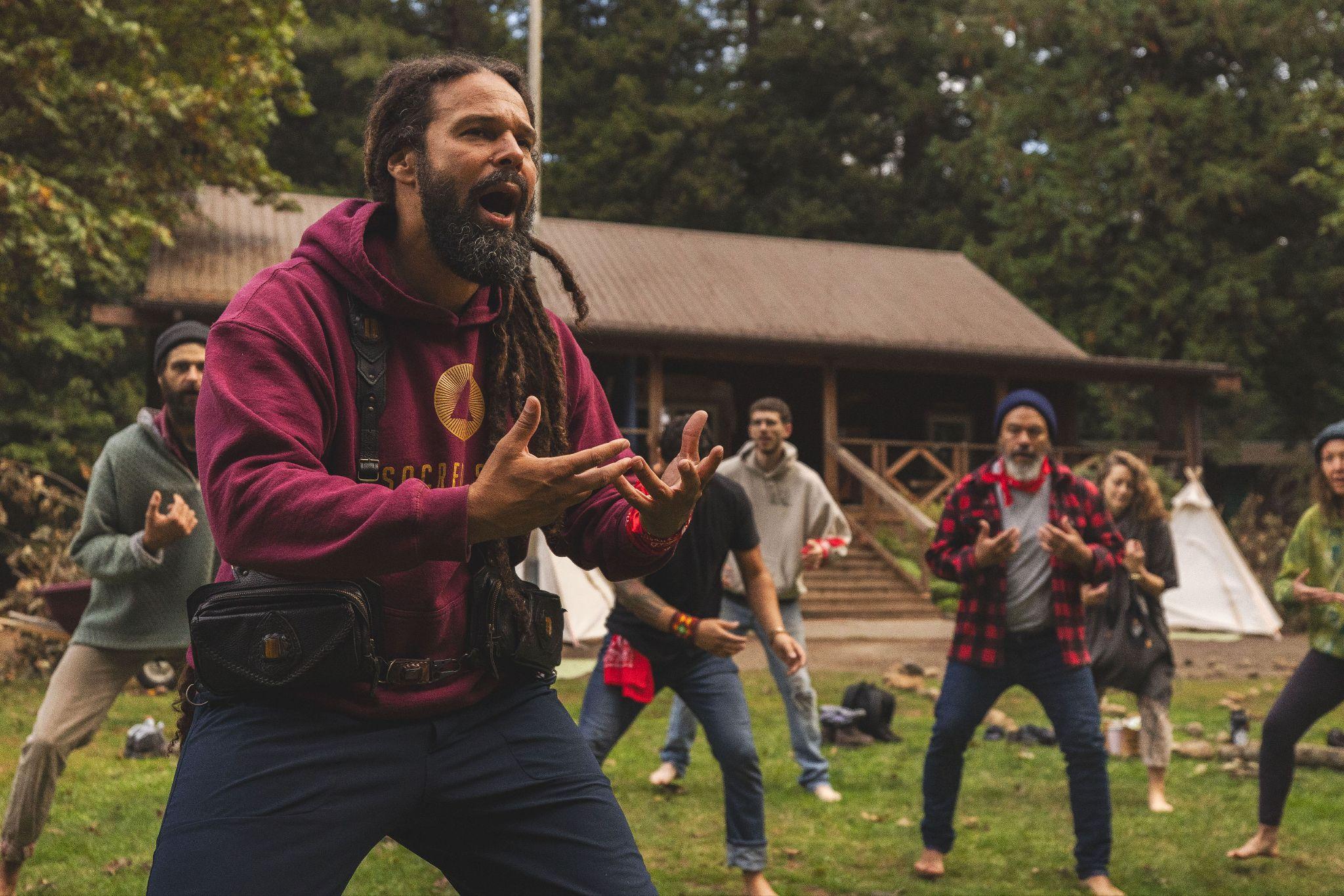
Modern trauma research has shown that overwhelming experiences can disrupt the body’s natural capacity for regulation. When the brain perceives threat—whether physical, emotional, or relational—the nervous system activates automatic survival responses designed to protect the individual. These responses occur through the autonomic nervous system, which regulates heart rate, breathing, muscle tension, emotional reactivity, and stress hormones. When traumatic experiences are unresolved or chronic, the nervous system may remain locked in patterns of hyperactivation or shutdown long after the original threat has passed.
This can lead to patterns such as hypervigilance, emotional numbing, dissociation, reactive anger, or difficulty trusting others. Research from leaders in trauma science—including Stephen Porges, and Peter Levine—has helped illuminate how trauma is stored in the body and how healing must involve physiological regulation as well as cognitive understanding. While these frameworks provide valuable insights, contemporary trauma-informed work increasingly recognizes the need to expand and adapt these models through more inclusive, gender-aware, and culturally responsive perspectives.
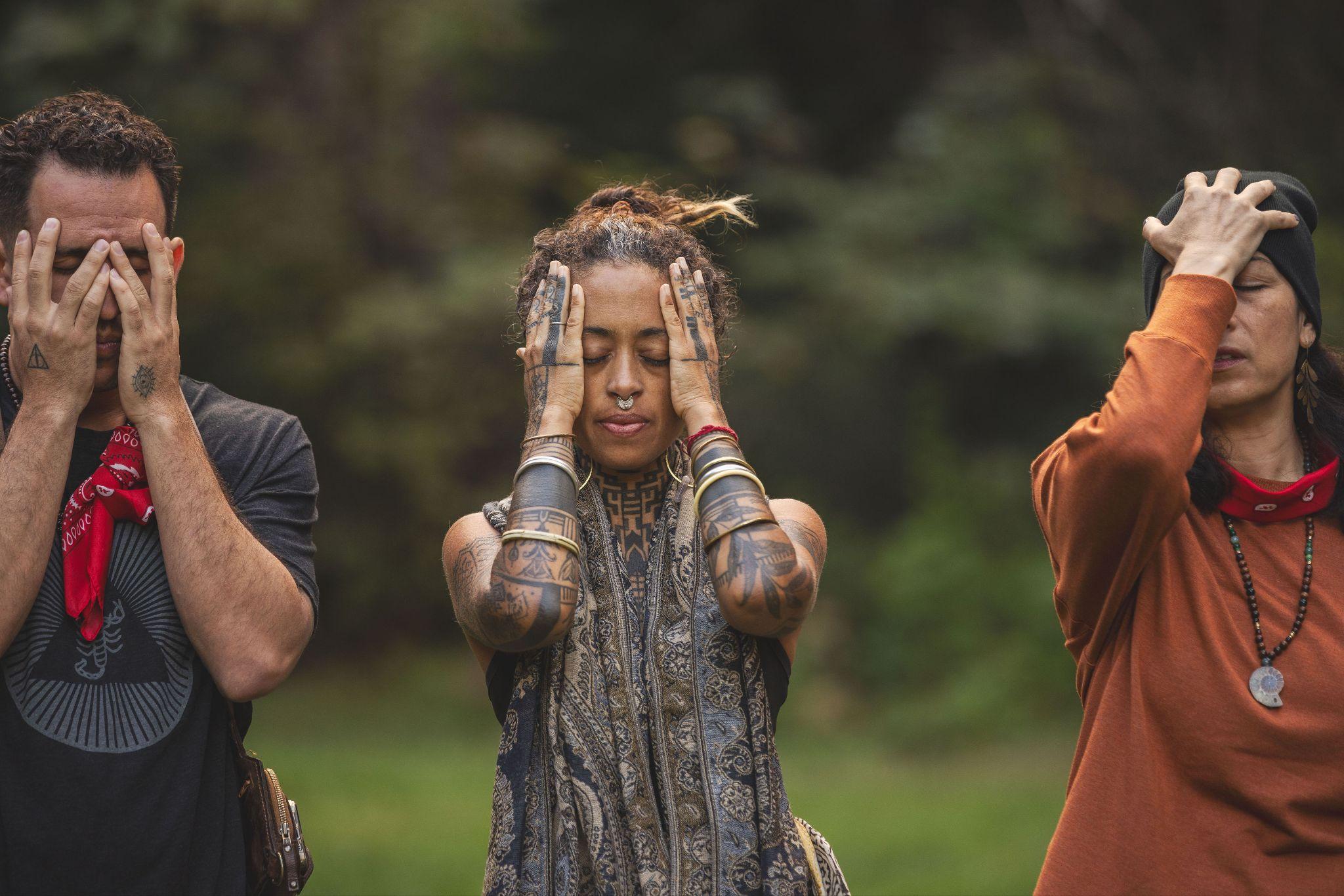
Inclusive Frameworks and Gender Awareness
The field of trauma research, neuroscience, and somatic psychology has contributed enormously to our understanding of how the nervous system processes stress, safety, and healing. However, much of the foundational research in physiology and neuroscience has historically been conducted on male subjects or generalized across populations without adequately accounting for gender differences in biology, socialization, and lived experience.
This training recognizes that women’s bodies, hormonal cycles, reproductive experiences, and social conditioning can influence how stress, trauma, and healing are processed in the nervous system. Research increasingly suggests that relational context, attachment dynamics, and social safety cues may play particularly significant roles in how many women regulate emotionally and physiologically.
For this reason, the Community Relational Training Framework integrates insights from neuroscience and somatic psychology while also drawing from women’s hormonal cycles, men & women’s healing traditions, relational psychology, and lived experiential knowledge.
Collective, Ancestral, and Ecological Trauma
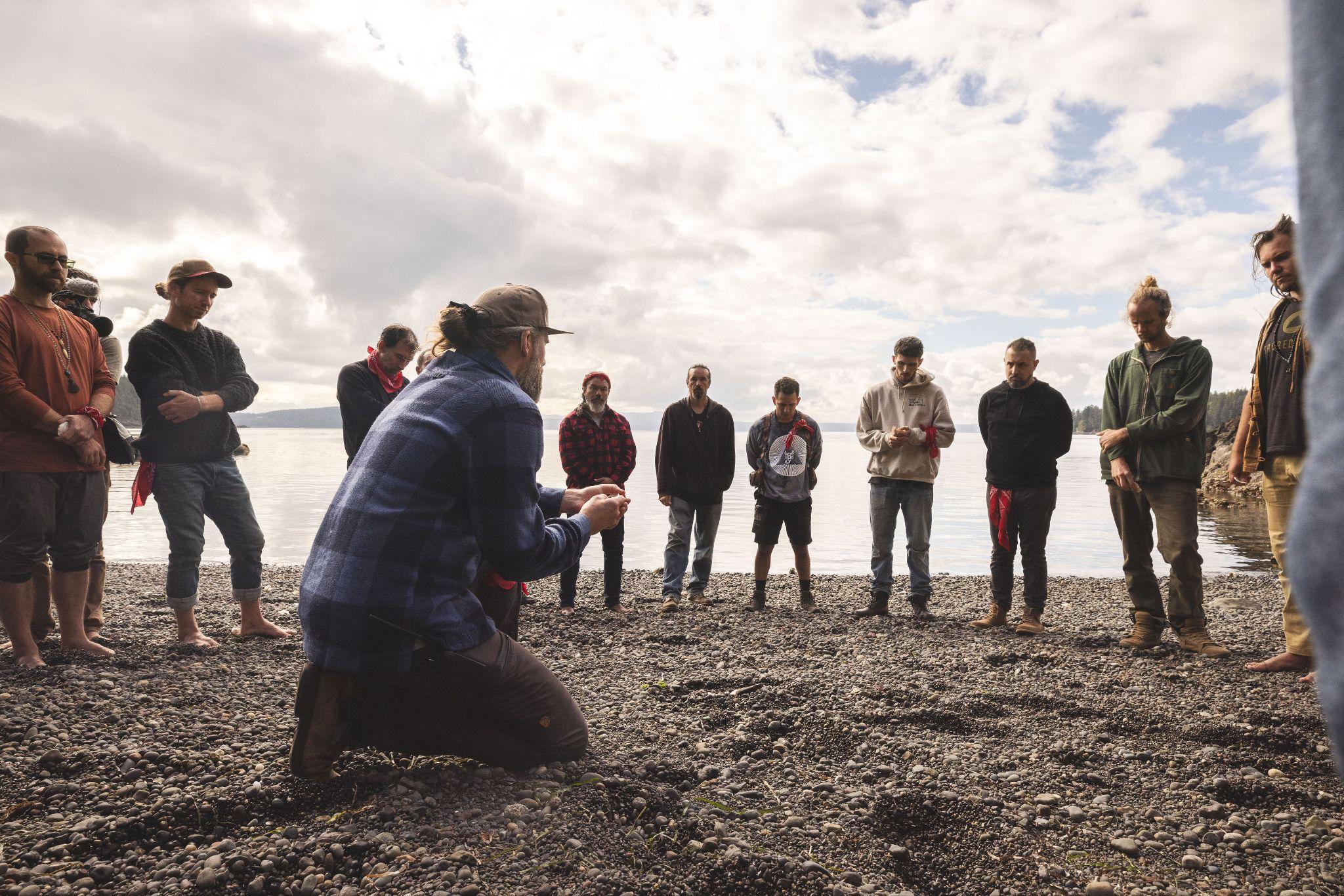
In addition to personal experiences, human nervous systems are shaped by broader social, historical, and environmental forces. Trauma can be transmitted not only through individual experiences but also through collective memory, intergenerational patterns, and cultural histories. Communities that have experienced war, displacement, colonization, systemic violence, or long-standing social inequality may carry collective trauma that influences how individuals experience trust, safety, and belonging. Similarly, ecological trauma—the psychological and physiological impact of environmental destruction, displacement from land, or climate-related stress—can deeply affect the nervous system and sense of identity within communities.
Indigenous and earth-based traditions have long recognized that human wellbeing is inseparable from the wellbeing of the natural world. When ecosystems are damaged or communities are disconnected from land, culture, or ancestral knowledge, this can create profound experiences of loss and disorientation.
Within the Community Relational Training Framework, healing is therefore understood as both an individual and collective process. Facilitators are invited to recognize that participants may carry layers of personal, ancestral, cultural, and ecological experience into the room. Holding space with this awareness encourages humility, compassion, and respect for the complex histories that shape each participant’s nervous system and relational patterns.
Nervous System Regulation and Co-Regulation
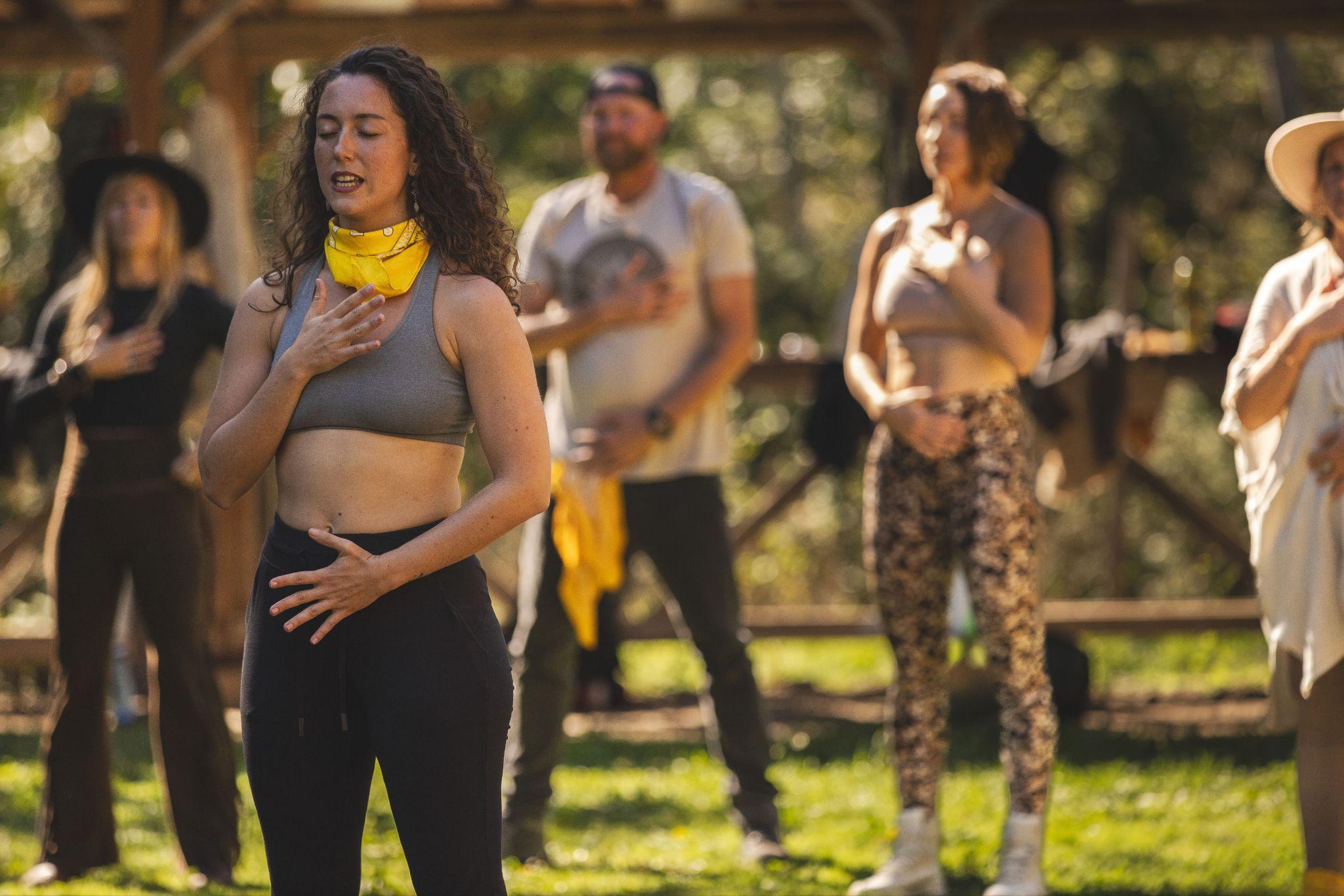
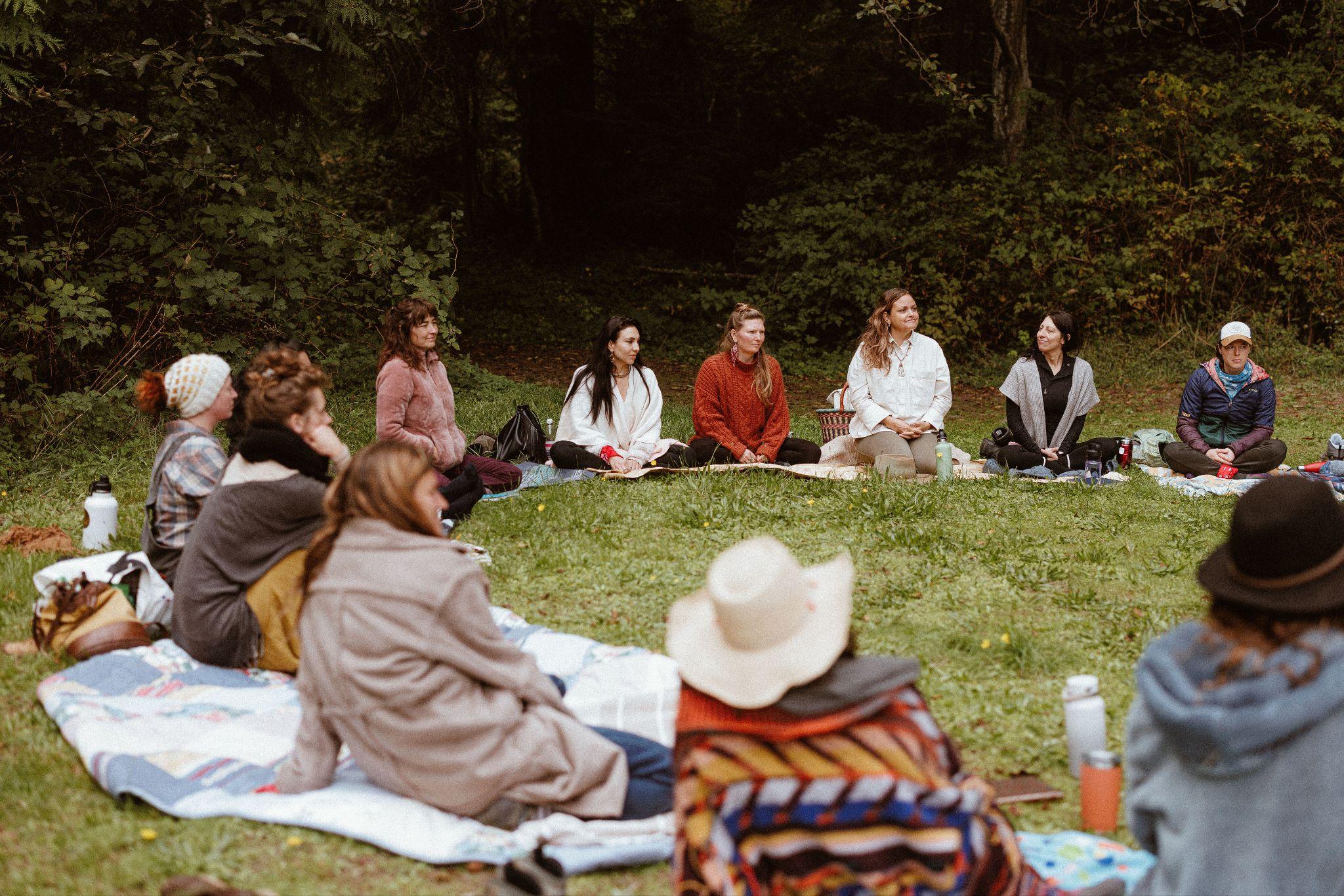
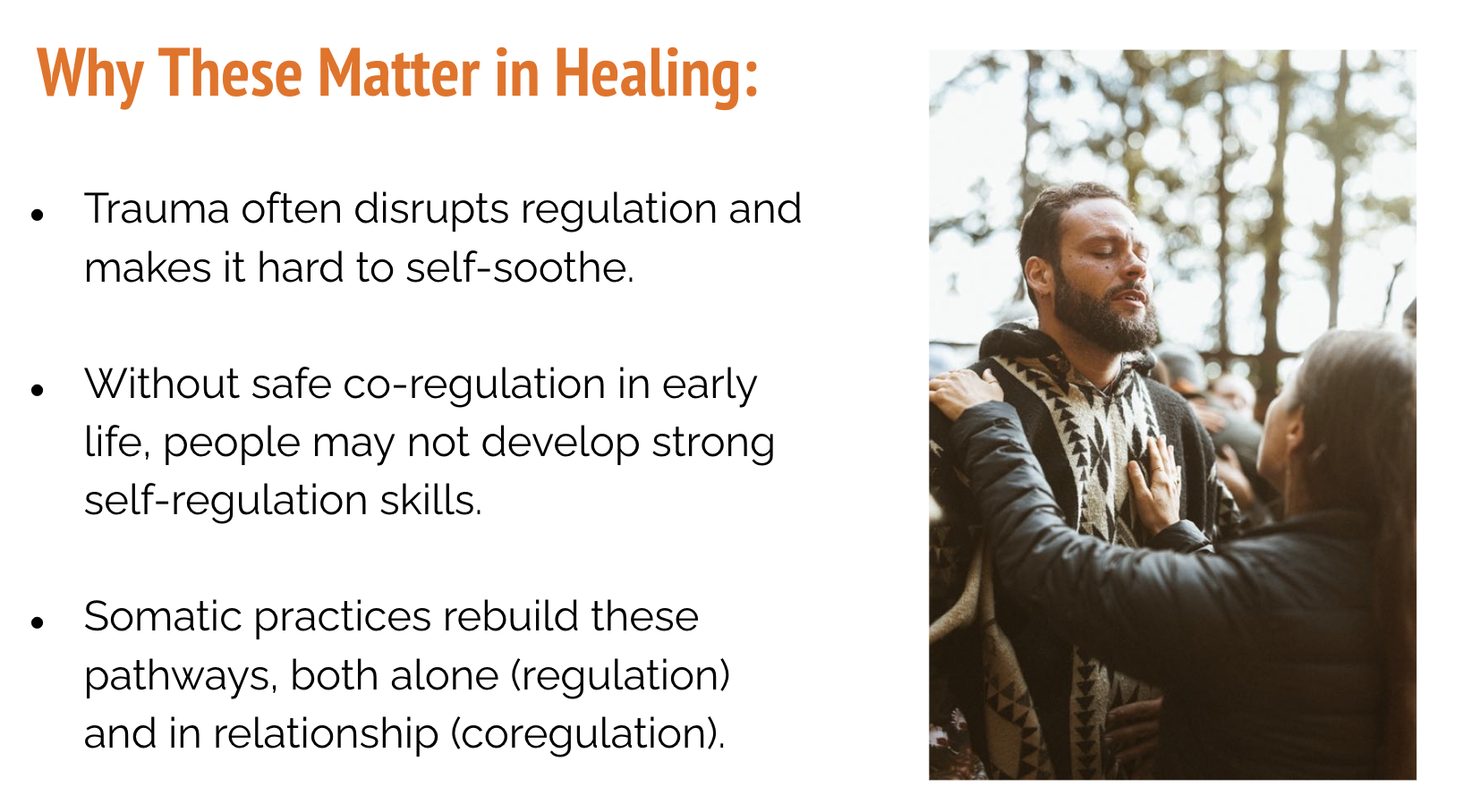
Human nervous systems are deeply social. Emotional states, body language, tone of voice, and facial expressions all transmit signals that influence how others feel and respond. This process, known as co-regulation, occurs when a regulated nervous system helps stabilize another. For facilitators, this means that your presence is one of the most powerful tools in the room.
When facilitators remain grounded and regulated, they help create a relational field in which participants feel safer expressing emotion, sharing truth, and engaging in difficult conversations. In contrast, when facilitators become overwhelmed or reactive, the group may unconsciously mirror that dysregulation. Learning to regulate one’s own nervous system—through breath, grounding, awareness, and pacing—is therefore a central leadership skill in relational facilitation.
Energetics
Energetics refers to the electromagnetic and bioelectric field generated by the human body — most significantly by the heart, which produces the largest electromagnetic field of any organ, detectable several feet outside the physical body. This field is not metaphorical. Research from the HeartMath Institute has shown that the heart's electromagnetic field carries information about a person's emotional state, and that this information is measurable in the nervous systems of people nearby. When two or more people are in close proximity, their body fields interact — influencing heart rate, brainwave patterns, and nervous system states in ways that happen below conscious awareness. In a group setting, this means that the collective emotional and physiological states of everyone in the room are literally merging and influencing one another. A facilitator who is genuinely calm, open, and present is not just modelling regulation — they are broadcasting a physiological signal that the bodies of participants receive and respond to. This is why experienced facilitators often speak of "holding the field" — it is both a somatic and an energetic reality. Understanding the body's energy field invites facilitators to take seriously not just what they do or say, but what they are carrying in their body when they walk into the room. This is why it is imperative to know yourself, be able to regulate yourself to be able to provide a safe space for participants.
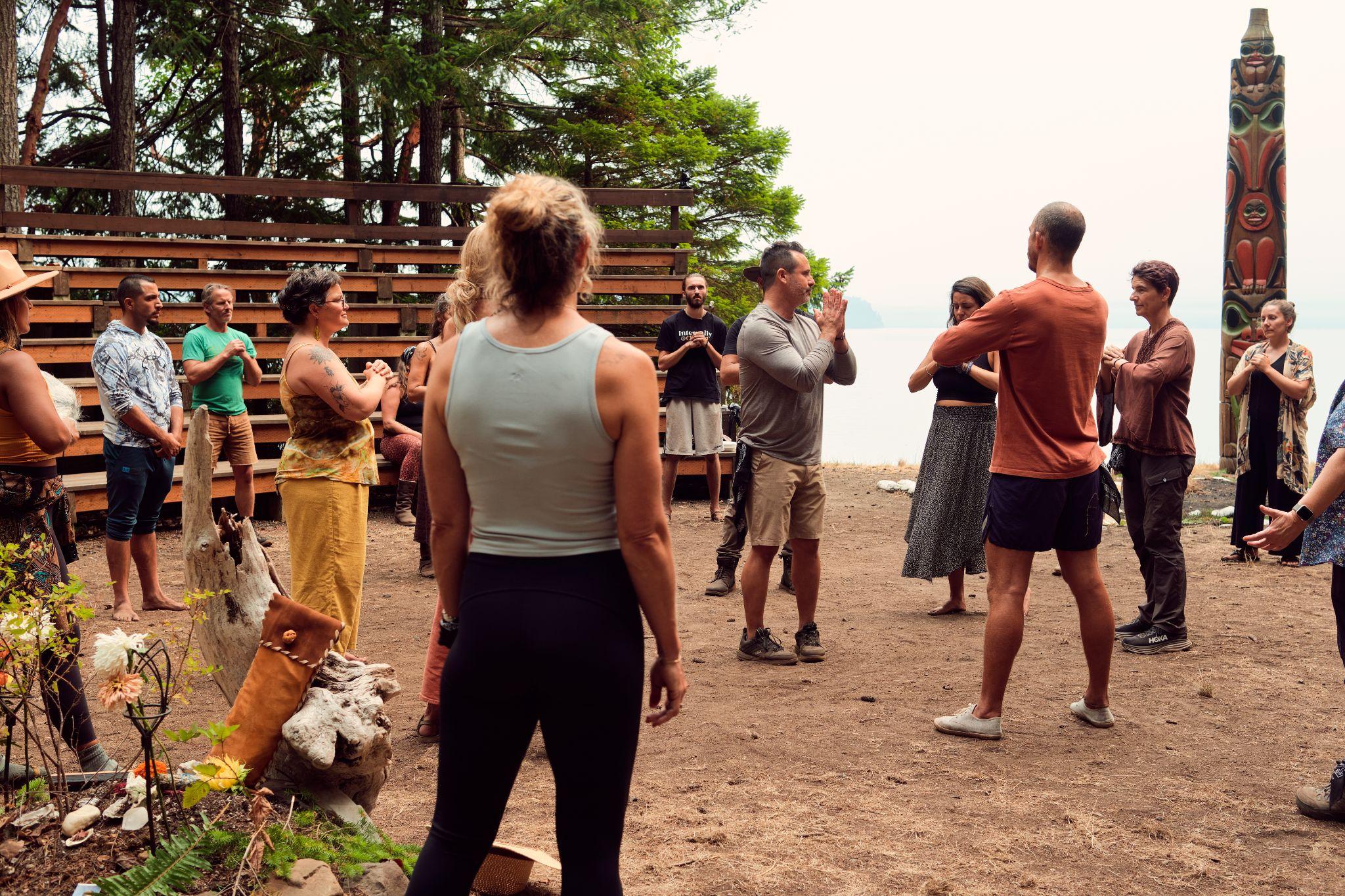
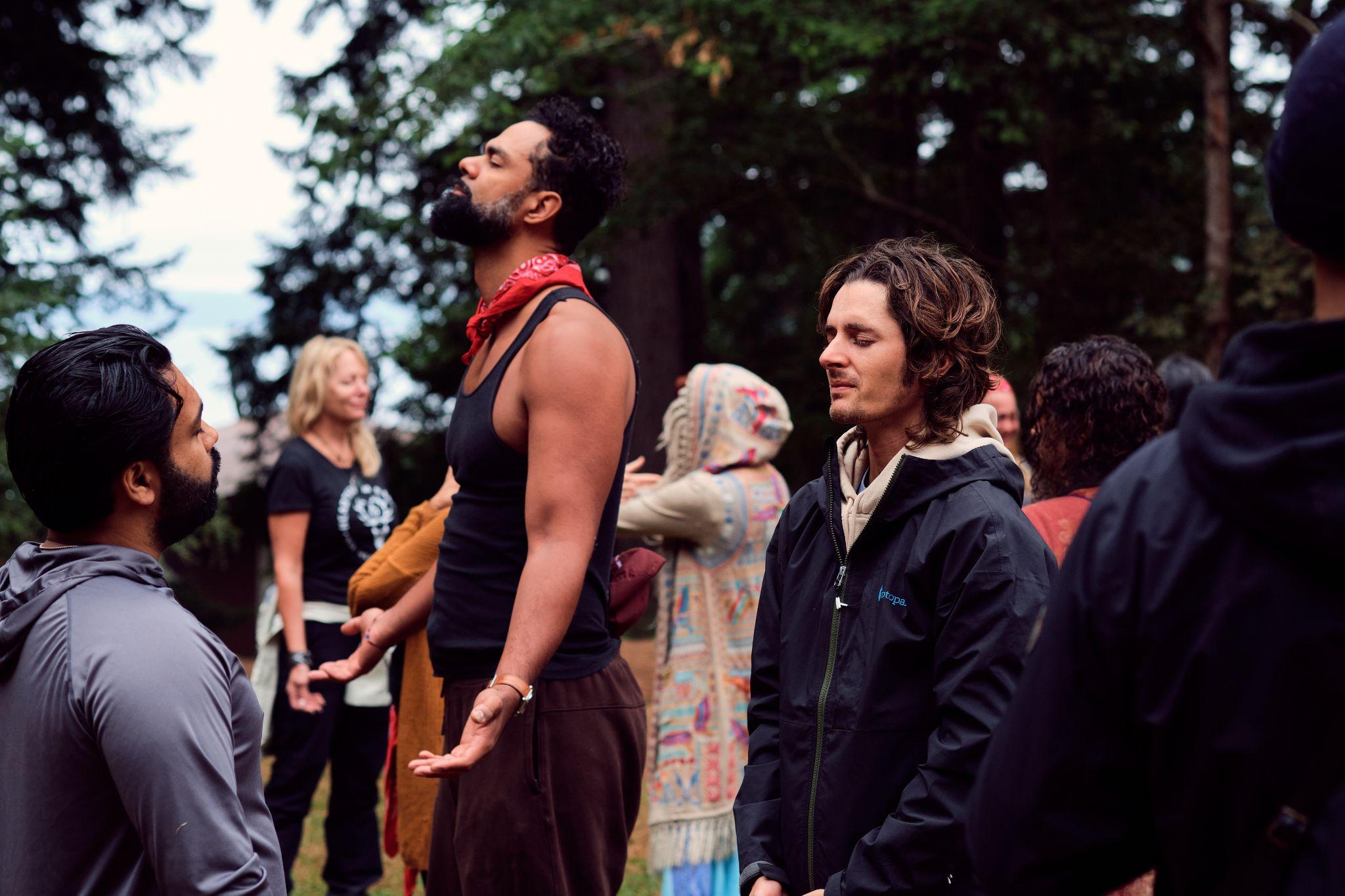
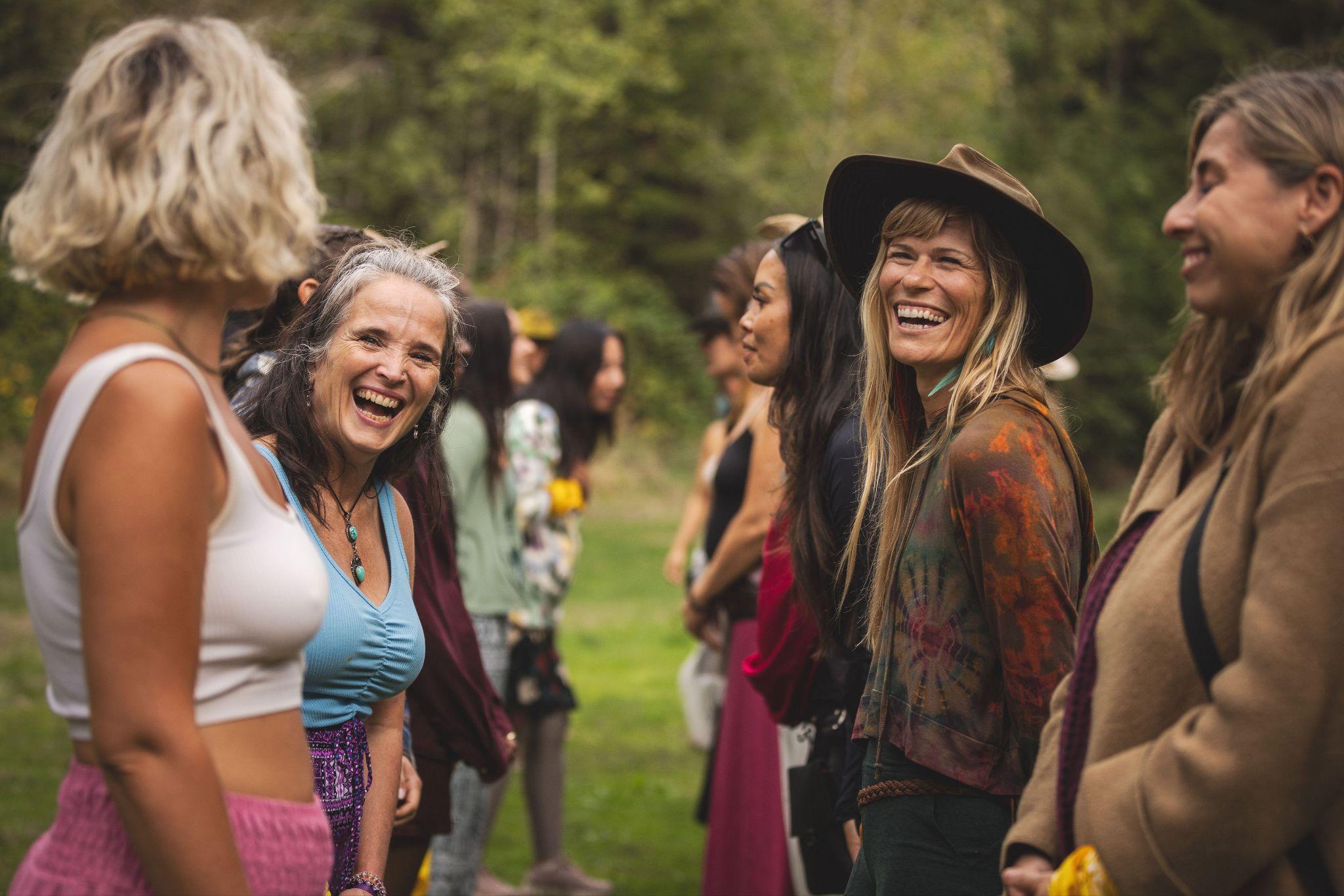
The group will most likely experience several pendulations, meaning the individual nervous system will enter a sympathetic state (fight or flight), and possibly freeze (shut down state, the dorsal vagal part of the autonomic nervous system), and then once that charge has a place to go (by doing something with the energy, like ‘running away,’ ‘tensing and flexing the muscles, or saying something outloud), their system can discharge the energy which brings them back down into this regulated state.
The facilitator’s role is to gently guide the group back toward this state of collective regulation through grounding practices, slowing the pace, reinforcing agreements and inclusion, or inviting participants to take a deep breath and reconnect with their bodies.
Over time, facilitators learn that the emotional intensity of a room is not something to fear. When held with care, structure, and awareness, these moments often become the doorway to deeper trust, repair, and transformation.
We can do this.
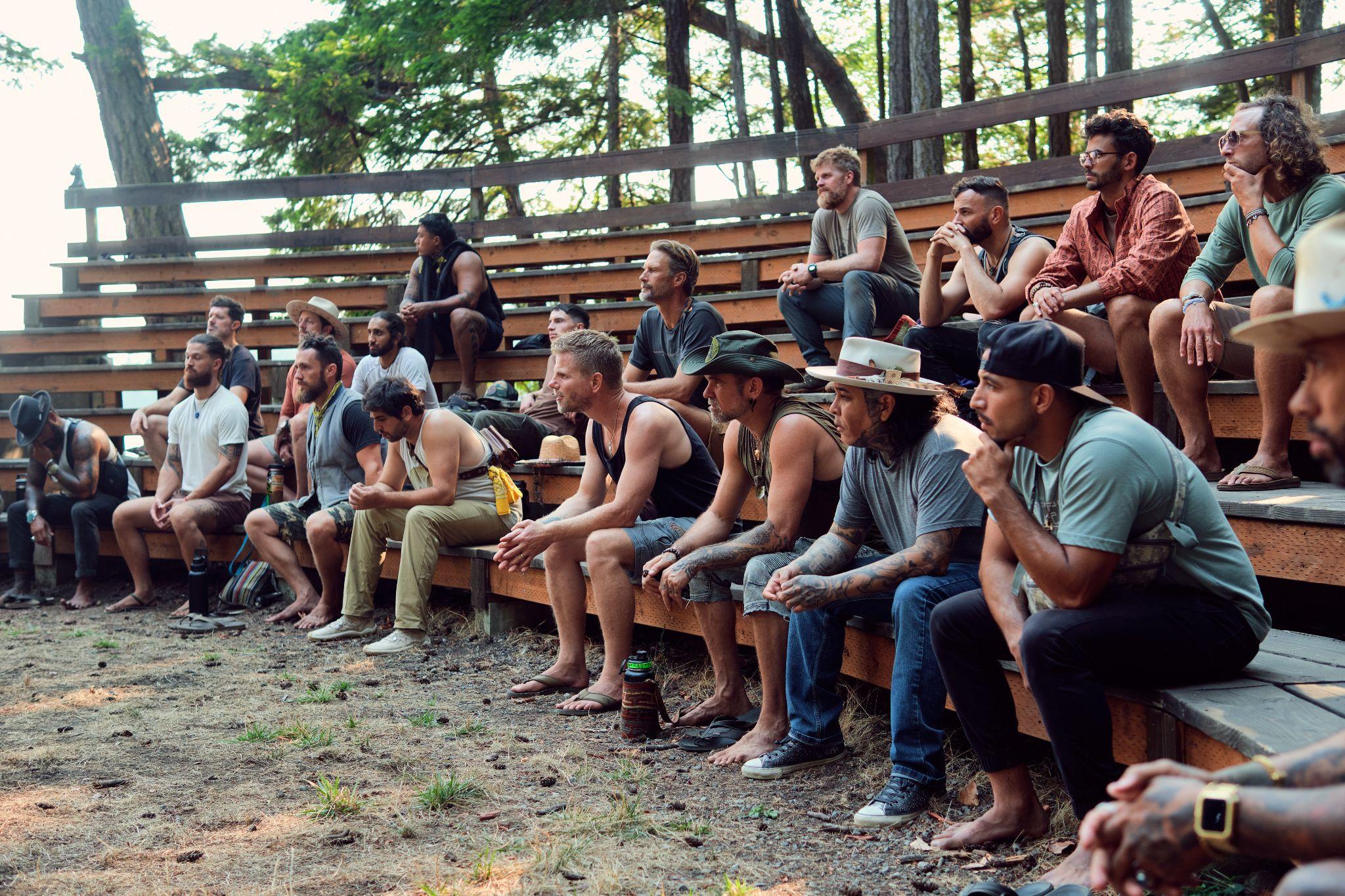
Somatic awareness allows facilitators to stay present without becoming overwhelmed, reactive, or overly controlling. Rather than ignoring body signals, facilitators learn to read them as information about the moment.
When facilitators remain grounded in their bodies, they help the entire group regulate.
Signs that the nervous system is finding balance include:
- Shaking or TremblingA natural mechanism to release adrenaline after a sympathetic ("fight-or-flight") response.
- Deep Sighs or YawnsSignals that the parasympathetic ("rest-and-digest") system is engaging.
- Muscle SofteningA release of chronic tension in the jaw, shoulders, and neck.
- Spontaneous Heat or ColdA feeling of warmth or a "vibe" moving through the body as energy releases.
- Spontaneous EmotionsSudden urges to laugh, cry, or express anger as emotional energy is processed.
- Spontaneous MovementsStretching, shifting, or "shaking it off" to release stored tension.
- Abdominal SoundsDigestive sounds indicating the body is moving from survival (inhibition) back to digestion
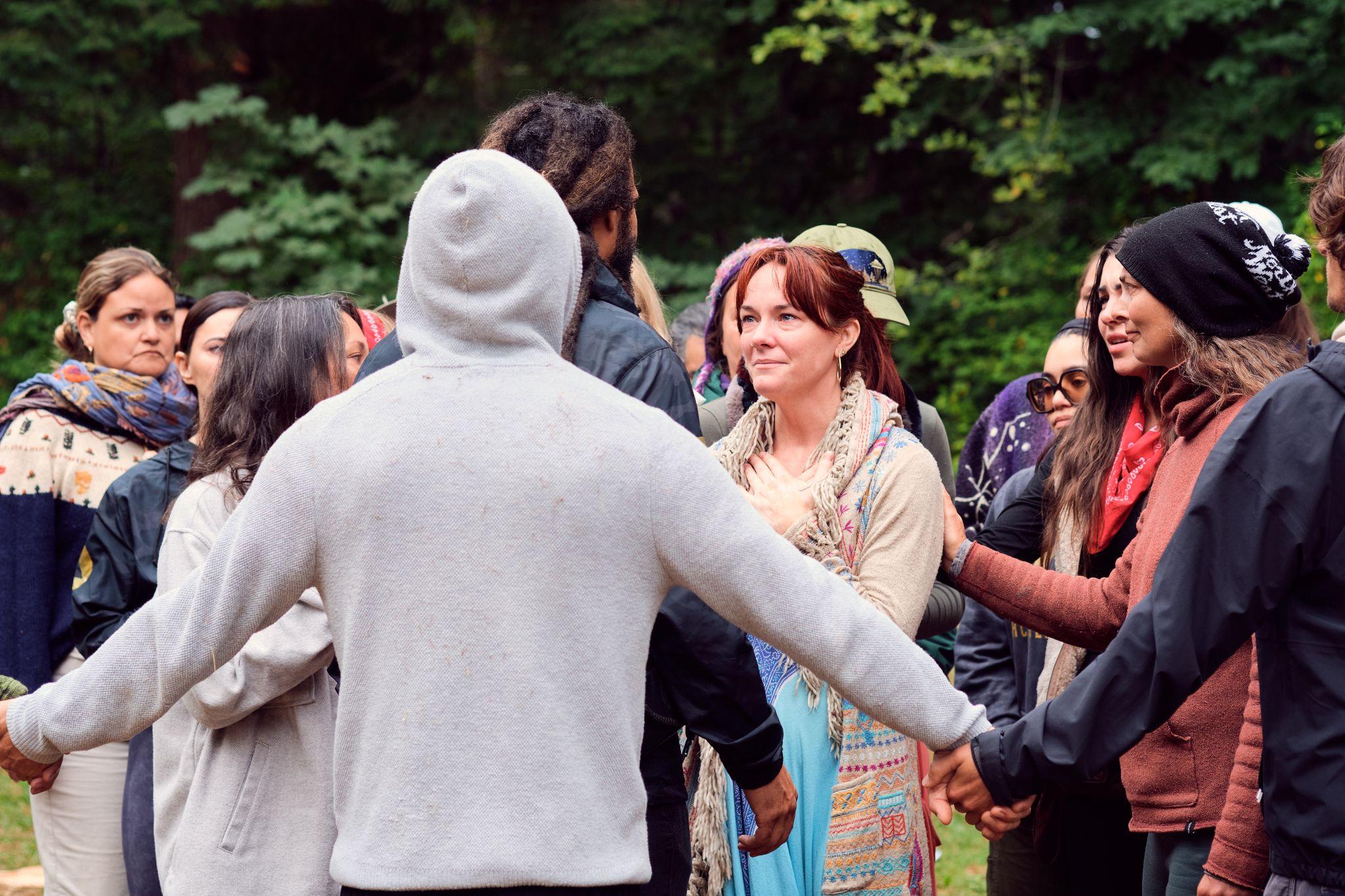
Somatic Signs of Overwhelm (Too Much)
Regulation becomes "too much" when the body is asked to process more than it can handle at once, often leading to a "relapse" into a dysregulated state (re-traumatization). This is often called overloading or getting stuck in "hyperarousal" or "hypoarousal".
Hyperarousal (Too Much "Gas")
When regulation techniques are forced too quickly, the system may swing into a panic state:
- Racing heart or palpitations: The body feels in immediate danger.
- Shallow, rapid breathing: An inability to take deep breaths.
- Panic attacks or intense anxiety: Feelings of urgent danger.
- Hyper-sensitivity: Loud sounds or bright lights feel physically painful.
- Trembling that does not stop: Shaking that becomes uncontrollable or distressing.
Hypoarousal (Too Much "Brake")
When the system is overloaded, it may freeze or shut down to conserve energy:
- Dissociation or Numbness: Feeling disconnected from your body, as if you are "leaving your body" during tough moments.
- Sudden, profound fatigue: An exhausting feeling that rest cannot fix ("wired but tired").
- Brain Fog: Inability to focus or make simple decisions.
- Feeling "flat" or unmotivated: A sudden lack of interest or joy.
When overwhelm or anxious (hyperarouse) - when we feel overwhelmed or anxious, here are some tools to help regulate the nervous system:
- Get the senses involved. Smell something, drink some tea/water, rub the hands together, rub the ears and listen for a sound.
- Orient to the environment: find something around to look at and notice something new or identify 3 things.
- Sigh deeply or hum: this stimulates that vagus nerve
- Gentle movement: walk around, shake the body, stretch and reach the sky.
- Ground the body: squat and touch the earth, feel the earth beneath your feet without your shoes, move the earth beneath your feet.
When we feel Numb or Disconnected (Hypoaroused) - when we feel numb or disconnected, here are some tools to help regulate the nervous system:
- Move Around: brisk walk, stretching, bouncing on heels, jumping jacks
- Use cold therapy: ice roll on the face, cold compresses, splash cold water on the face and neck or a cold shower, swim or plunge.
- Engage the voice: sing, talk or read something aloud.
- Connect with a friend and ask for a hug (co-regulation)
Reading the Nervous System of the Room
Recognizing Collective States of Regulation and Dysregulation
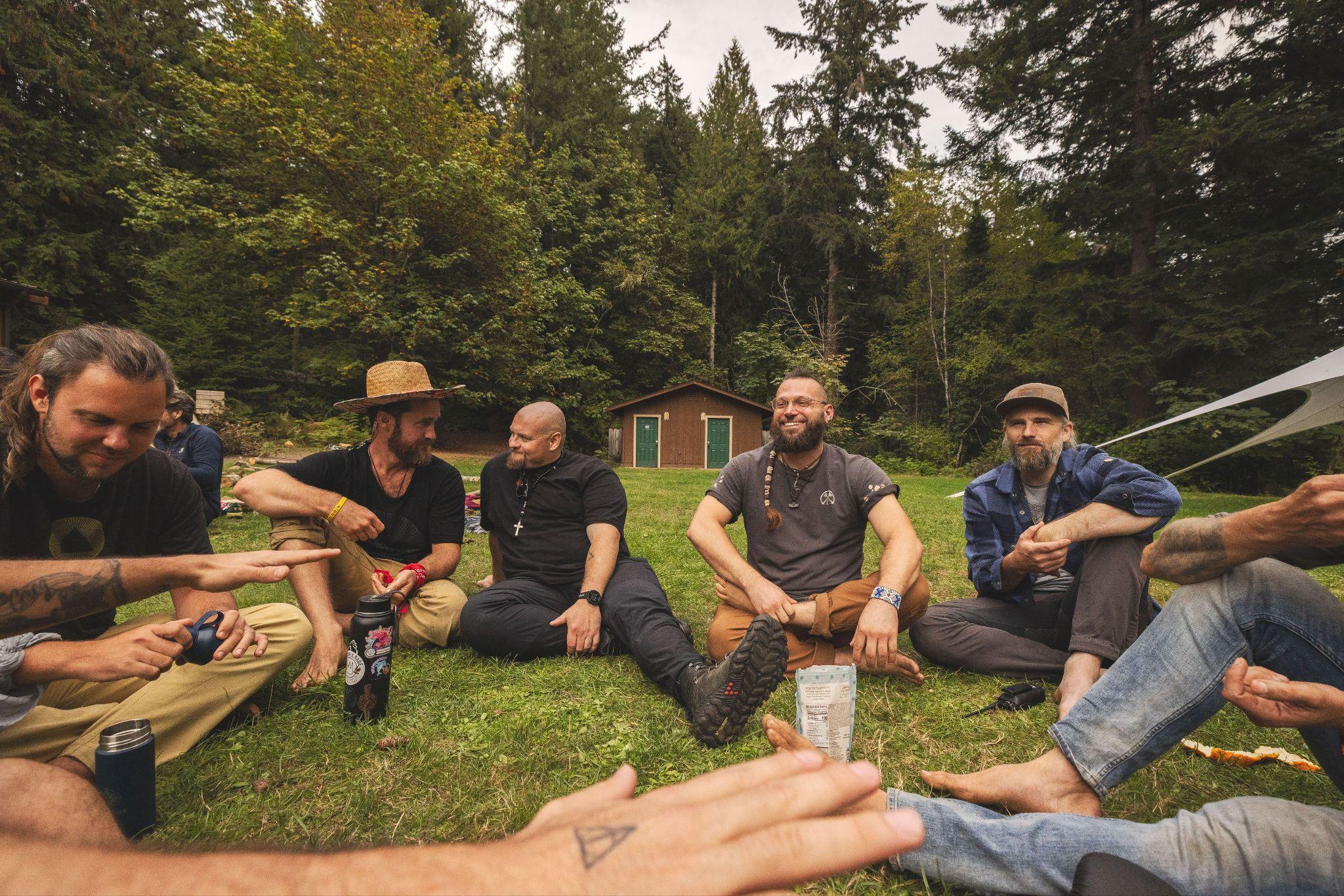
Just as individuals move through different nervous system states, groups do as well. A facilitator’s role is not to control the emotional experience of the group, but to recognize when the collective nervous system is shifting toward activation or collapse and respond skillfully.
Groups naturally move through waves of energy—moments of openness, vulnerability, tension, grief, and relief. These movements are part of authentic relational work. However, when the group nervous system becomes overwhelmed or fragmented, the facilitator may need to slow the process, re-ground participants, or restore clarity and safety.
Regulation is your nervous system's ability to return to a state of balance or calm after stress, challenge, or stimulation. It's the internal process of managing arousal, emotions, and energy levels so that you can function and respond appropriately to life’s demands.
In somatic terms, regulation includes:
- Returning from fight, flight, freeze, or fawn states back to safety and connection.
- Noticing and self-soothing bodily sensations like tightness, heart racing, or numbness.
- Using tools like breathwork, movement, grounding, or mindfulness to settle the body.
Examples
- Taking slow breaths after a stressful conversation.
- Stretching or moving when you feel frozen or stuck.
- Placing a hand on your heart to soothe rising anxiety.
Co-regulation is a shared nervous system experience—it's how humans help regulate each other through connection, especially through nonverbal cues like tone of voice, eye contact, presence, and touch.
In body somatics, coregulation looks like:
- A calm facilitator helping an individual feel safe just by being attuned and grounded.
- Two people sitting in silence, breathing together after a triggering somatic experience.
- Making eye contact and breathing together.
Why Somatic Work Matters in Community Healing
When communities engage in relational reconnection—especially across differences such as gender, culture, or historical harm—strong emotions that are deeply held experiences may surface. Without somatic awareness, these moments can quickly escalate into conflict, shutdown, emotional overwhelm or even re-traumatization.
Somatic exercises are safe body-centered practices designed to release physical tension, process emotional fibers, and promote calm through the mind-body connection. These techniques work by bringing awareness to physical sensations and using gentle movements to foster relaxation.
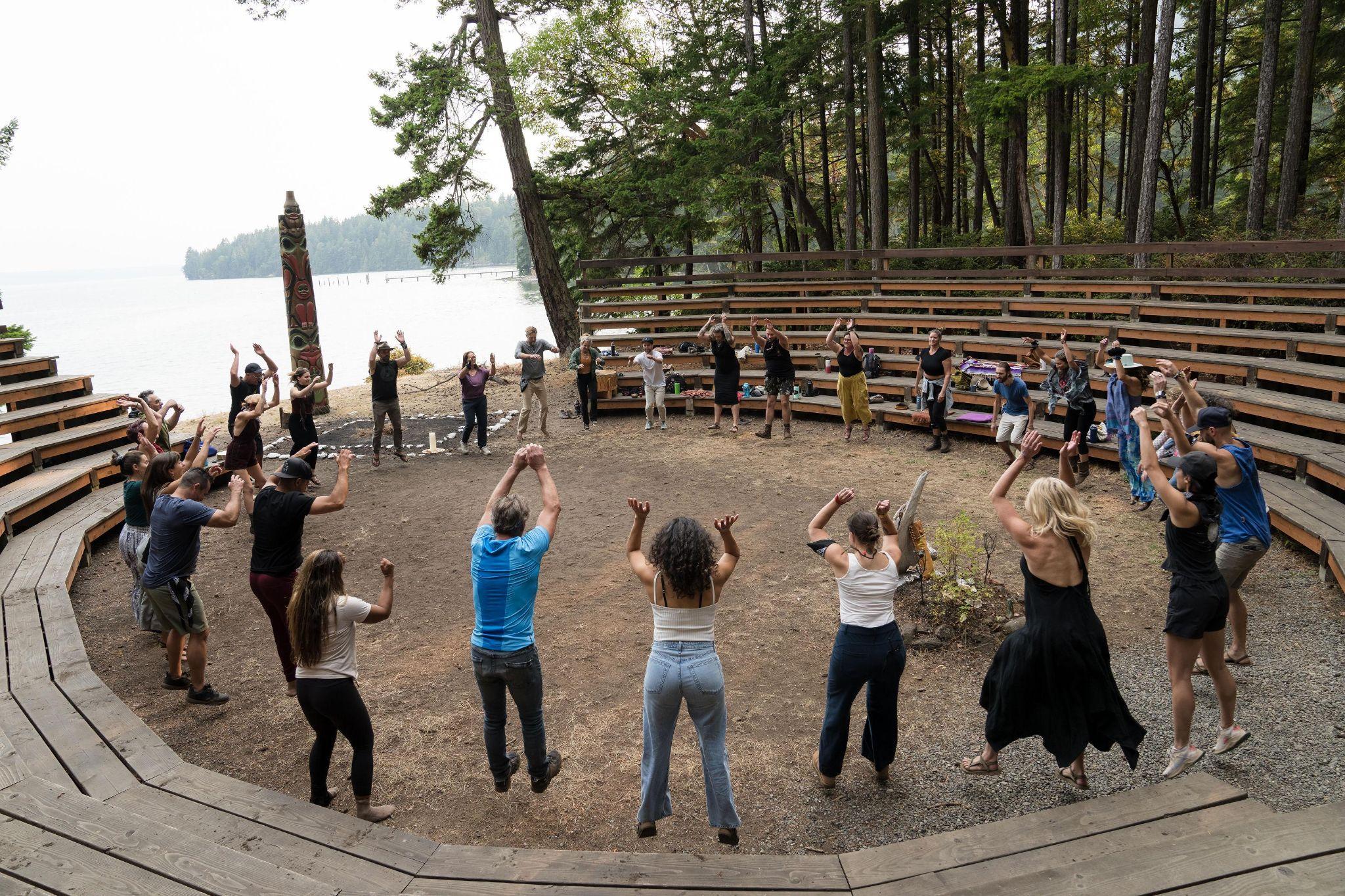
When leading a group, it’s vital to start with the body and have physical connection and awareness.
These somatic practices help participants to:
• recognize their own nervous system responses • slow emotional escalation • remain present in difficult conversations • experience safety within relational spaces • integrate insight through embodied awareness
Somatic Patterns in Men
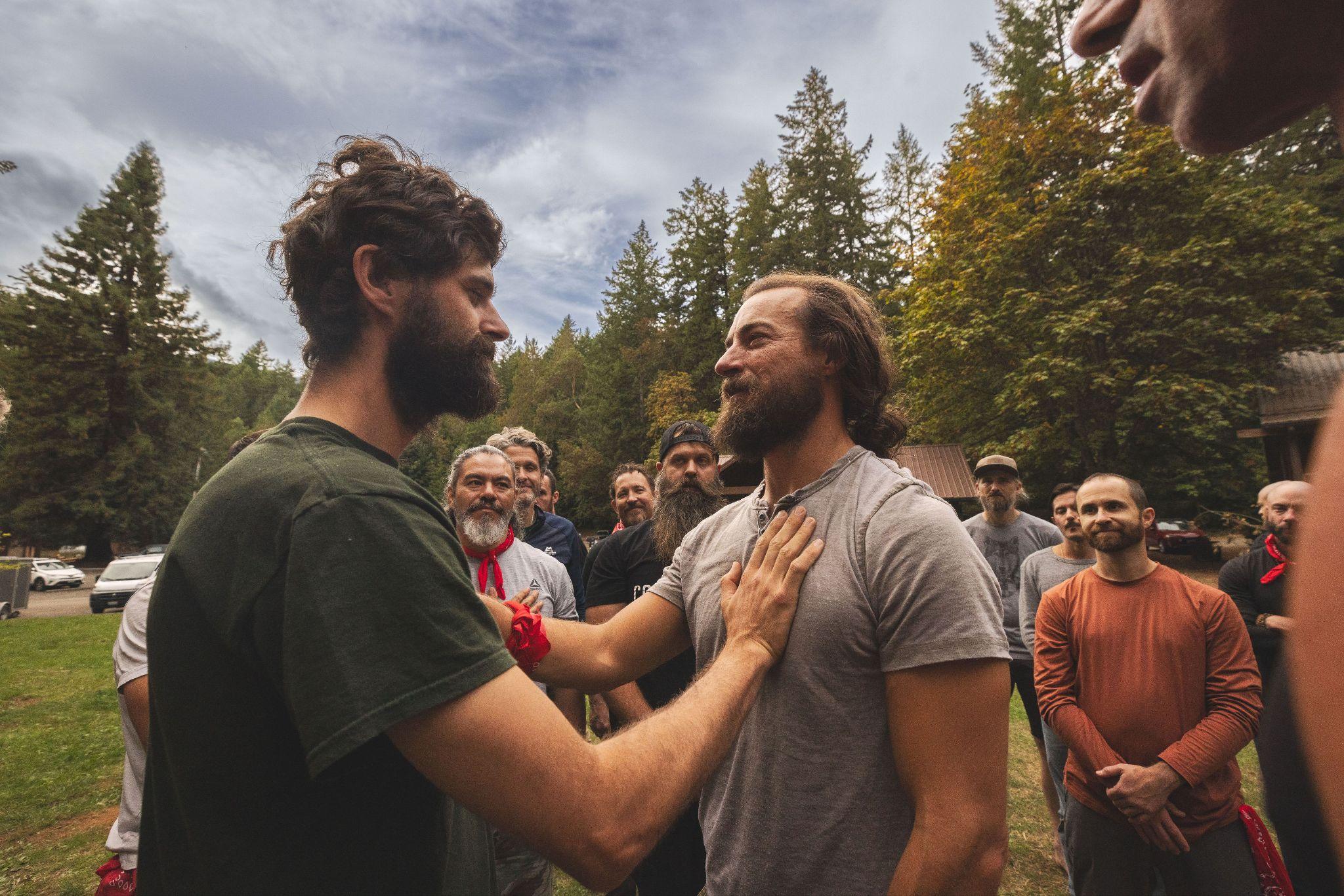
Globally, research from the World Health Organizaiton estimates that 1 in 10 men report having experienced sexual abuse as children, and 1 in 4 report having been physically abused in childhood. Men also face significant exposure to violence across their lifetimes — men aged 15–44 account for 60% of all interpersonal homicide victims globally, making it the third leading cause of death in that age group.
These experiences, too, leave their mark on the nervous system and body, shaping how safety, trust, and voice are experienced. We must be aware of the embodied experience of men who enter this space with us.Many men have been conditioned to disconnect from emotional sensation in the body. Cultural expectations around strength, control, and independence often encourage men to suppress vulnerability and prioritize problem-solving or action.
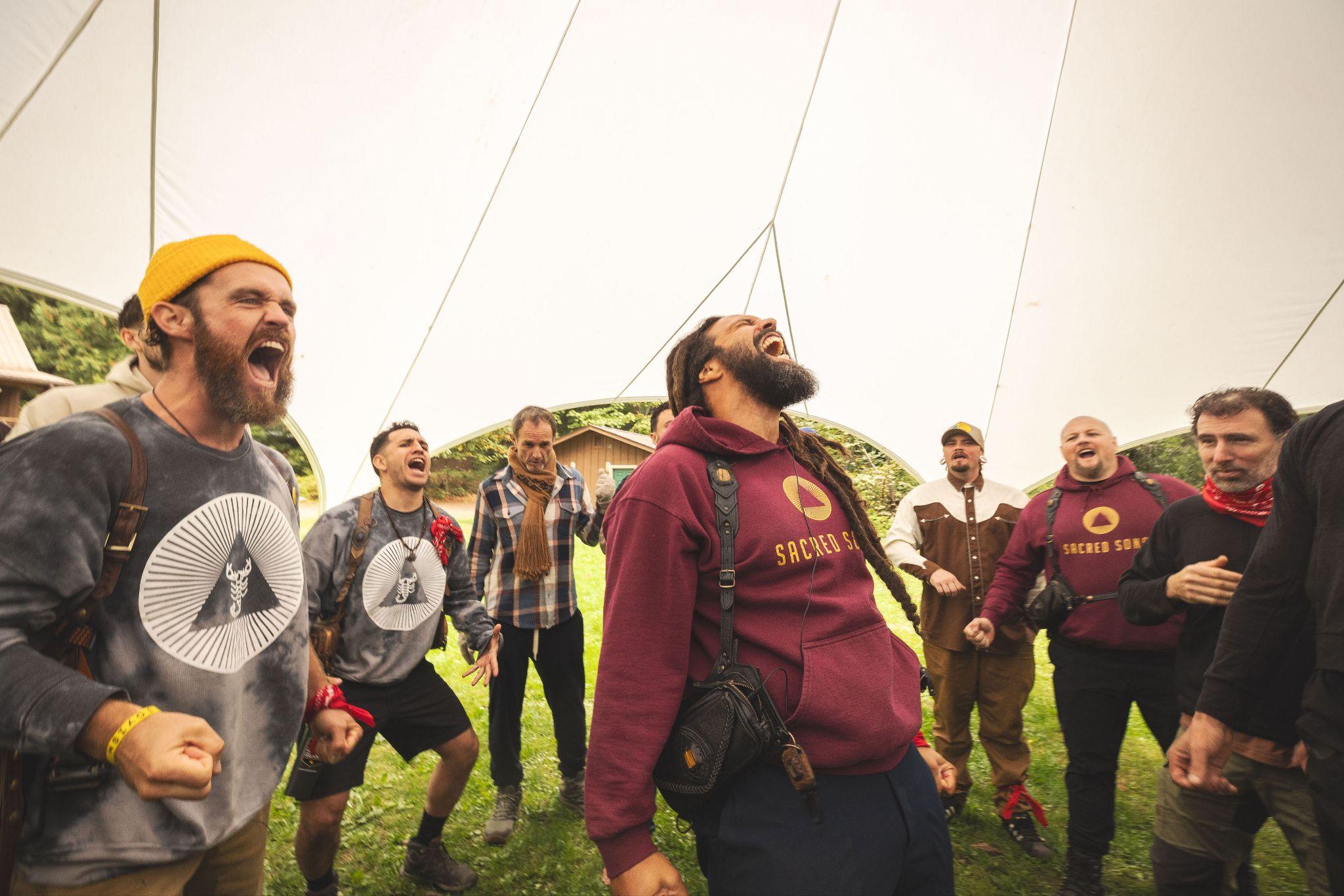
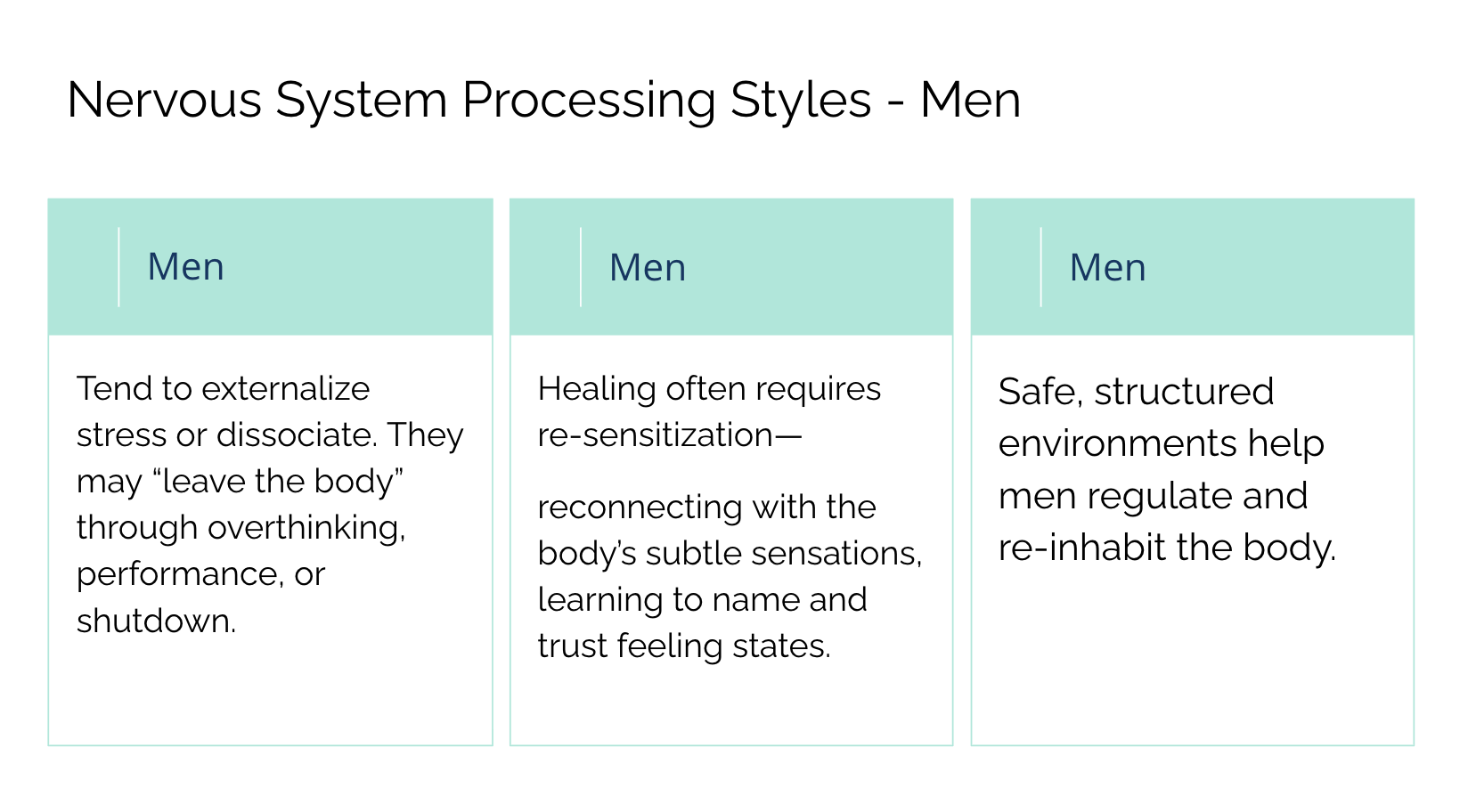
Men’s hormonal shifts are more linear or performance-oriented (driven by testosterone), which often translates into bursts of intensity followed by withdrawal. Healing may benefit from challenge, clarity, and contained ritual or practices like ritual combat, relational magnetics, and ritual connection.
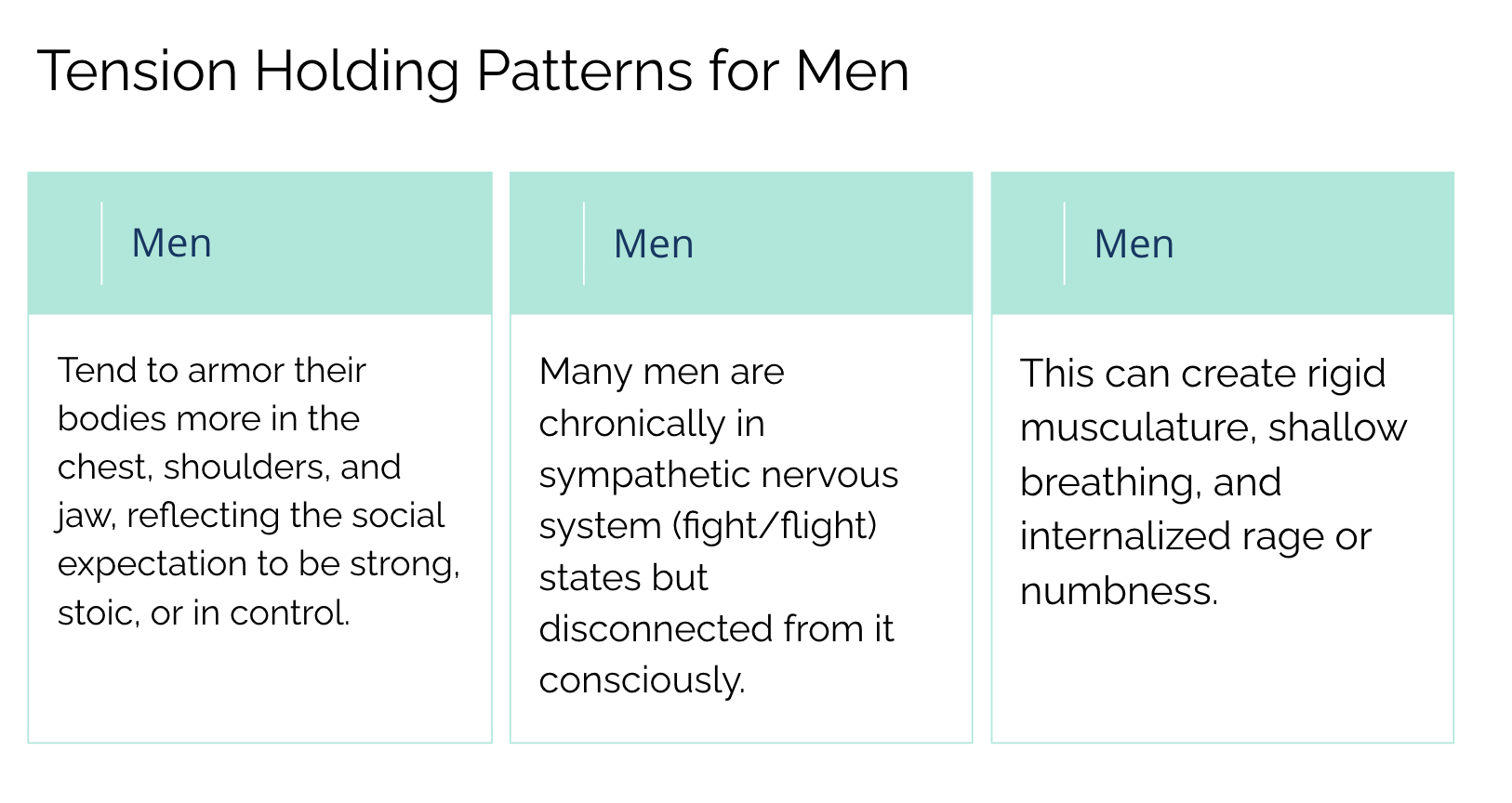
When emotions surface in group spaces, these responses are often misunderstood as resistance or lack of care. In reality, they are frequently protective nervous system strategies developed over time.
Somatic Patterns in Women
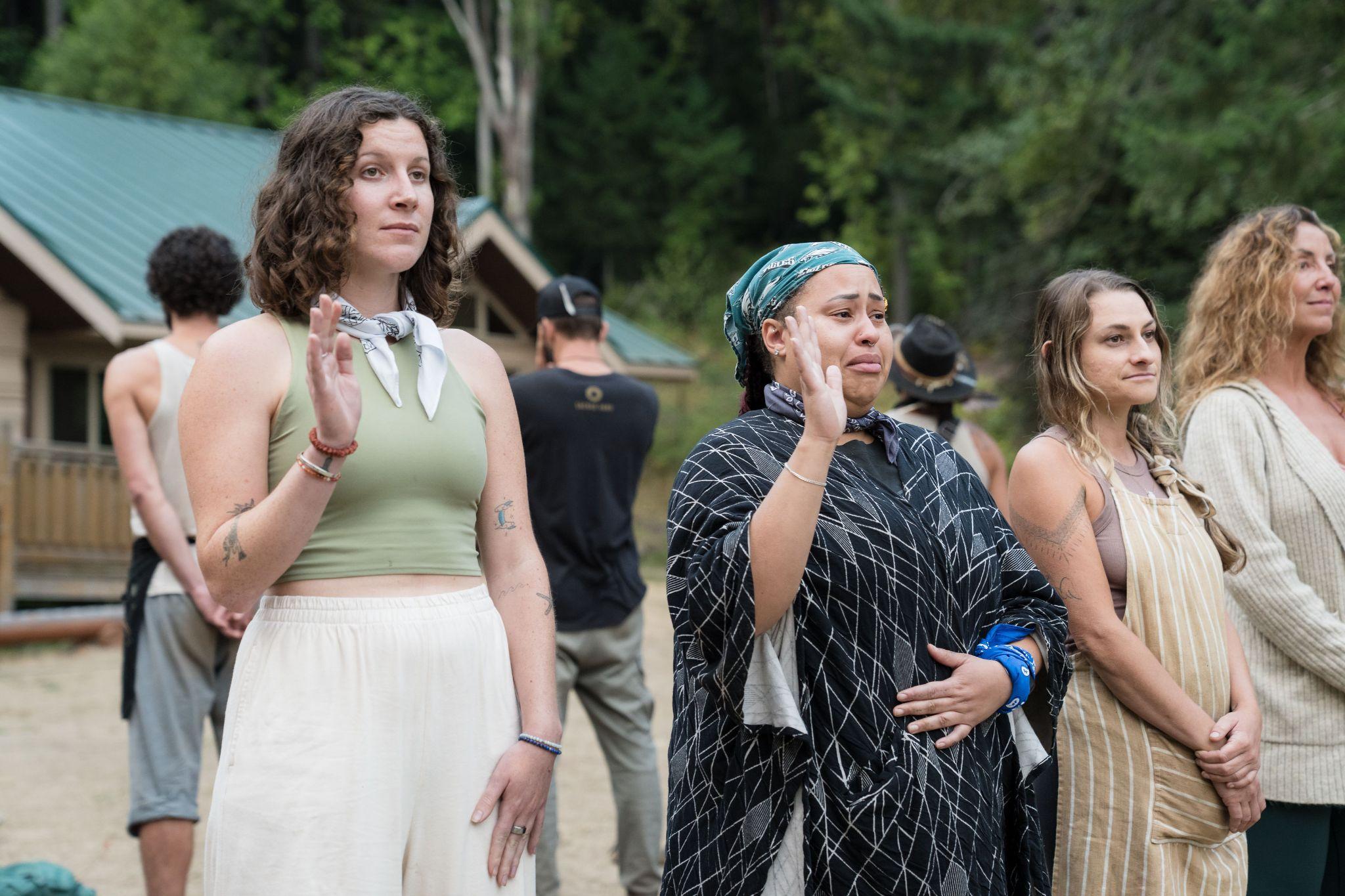
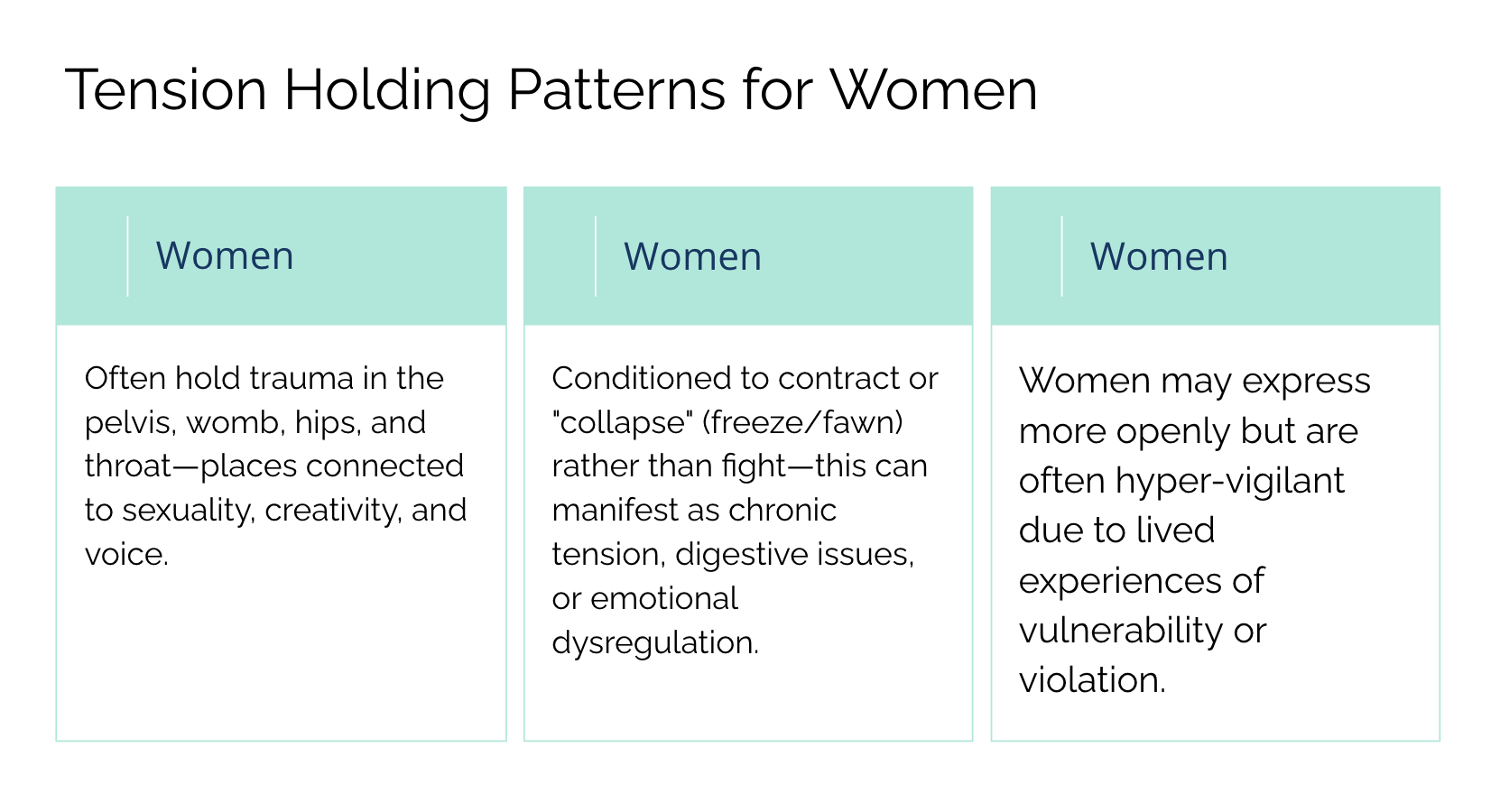
Globally, the World Health Organization estimates that 1 in 3 women — nearly 840 million — have experienced partner or sexual violence in their lifetime, a figure that has barely changed in over two decades. This violence begins early, with 12.5 million adolescent girls subjected to it by an intimate partner before their 20th birthday. These realities imprint not only on the mind, but on the nervous system and body, shaping how safety, trust, and voice are experienced. We must be aware of the embodied experience of women who enter this space with us.
Women are often socialized to maintain relational awareness and emotional attunement within groups and families. While this capacity for attunement can be a profound strength, it can also lead to nervous systems that become highly sensitive to relational tension and emotional labor. It’s vital to understand that women’s bodies have been a point of contention throughout history. Within each woman is the pain, joy and epigenetics of generations before her - she carries much of this in her womb space. It is vital to understand what timeframe she is connected to currently; maiden, mother, sage/crone and her hormonal cycle.
Women’s bodies are cyclical—their emotional and somatic states shift with menstrual, lunar, and life cycles (pregnancy, menopause, etc.). Healing tends to be fluid, rhythmic, and honor rest and inner listening.
Many women have learned to monitor the emotional environment closely in order to maintain safety or harmony. Over time, this can lead to chronic vigilance, exhaustion, or collapse when boundaries are not respected.
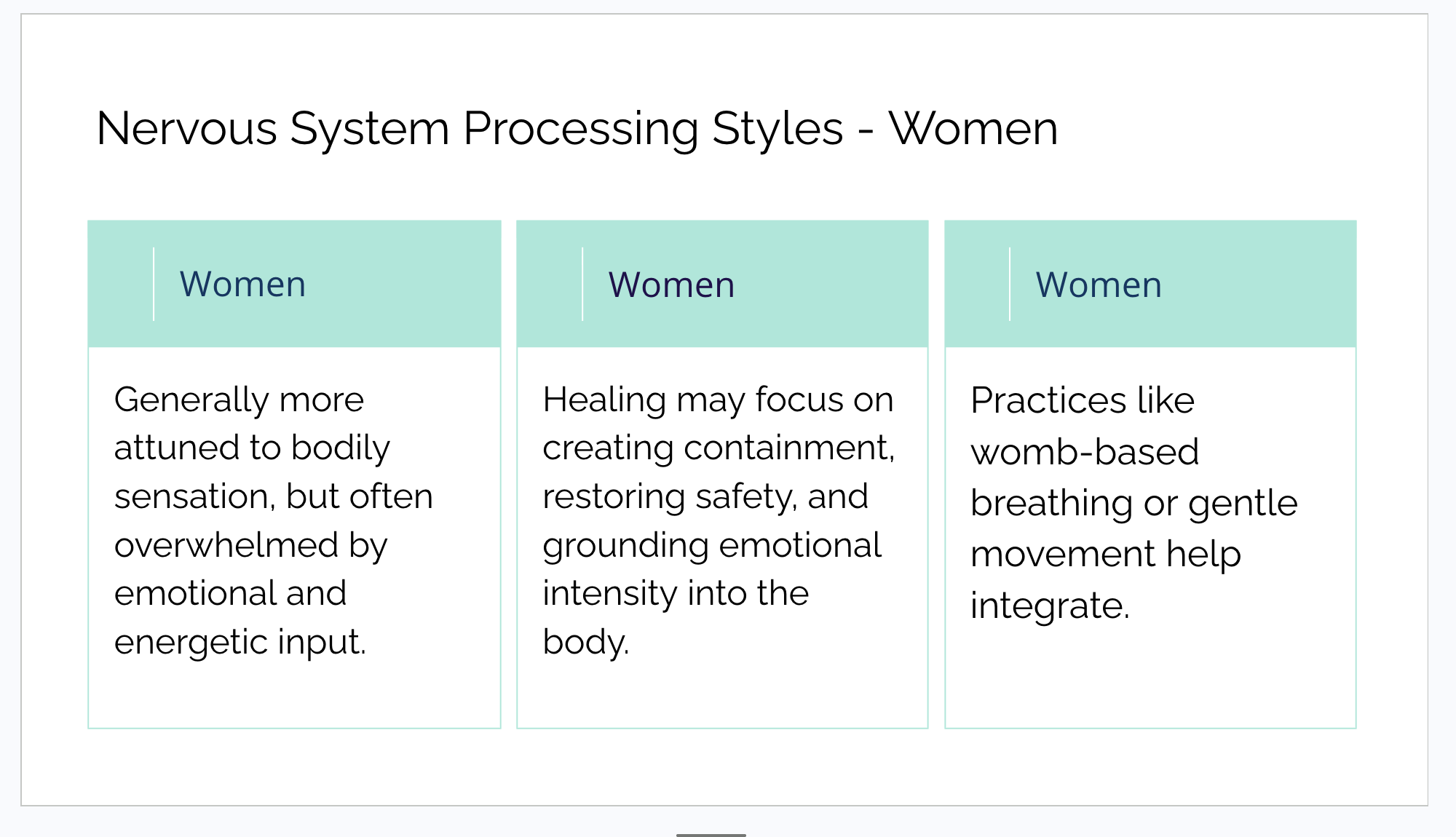
A Women’s Cycle - the menstrual cycle is not a limitation—it’s a biological intelligence system that offers unique opportunities for inner connection, healing, and regulation. Also be mindful of the age; maiden (birth - 25+), mother (25-50+) sage/crone (50+-wisdom/elderhood).
Menstrual Phase (Days 1–5): Bleeding
Body state: Low energy, inward, heightened sensitivity Somatic focus: Restorative, inward, slow, womb-aware
Follicular Phase (Post-bleed, Days 6–13): Rising Energy
Somatic focus: More dynamic movement, expressive practices, body confidence
Ovulation (Days 14–17): Peak Energy, Outward Focus
Safety Guidelines for Menstrual Somatic Work
- Honor what the body wants—don’t push through exhaustion
- Use practices that support rest, release, and gentle awareness
- Include womb-awarenessbreath, touch, voice, visualization
- Create space for grief or ancestral memory to surface
- If doing trauma workbe extra resourced, held, and choiceful
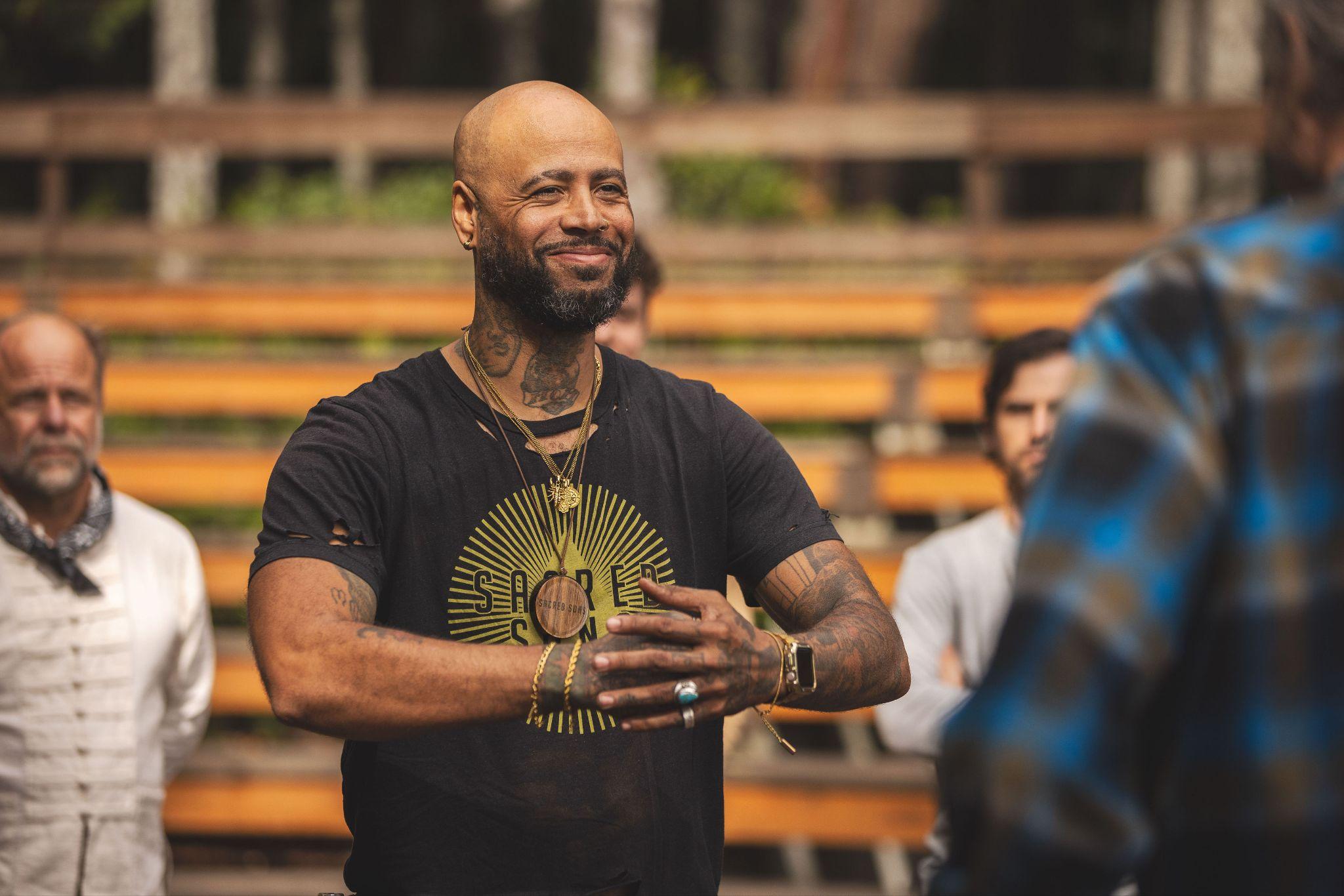
Once facilitators have done foundational somatic work within their own gendered experience, co-facilitation becomes a powerful model for relational healing.
When men and women facilitate together with awareness and respect, they demonstrate a different way of being in relationship:
- listening without defensiveness
- honoring emotional truth without collapsing into blame
- sharing leadership rather than competing for authority
- practicing accountability while maintaining dignityParticipants are not only learning relational skills—they are witnessing them embodied.
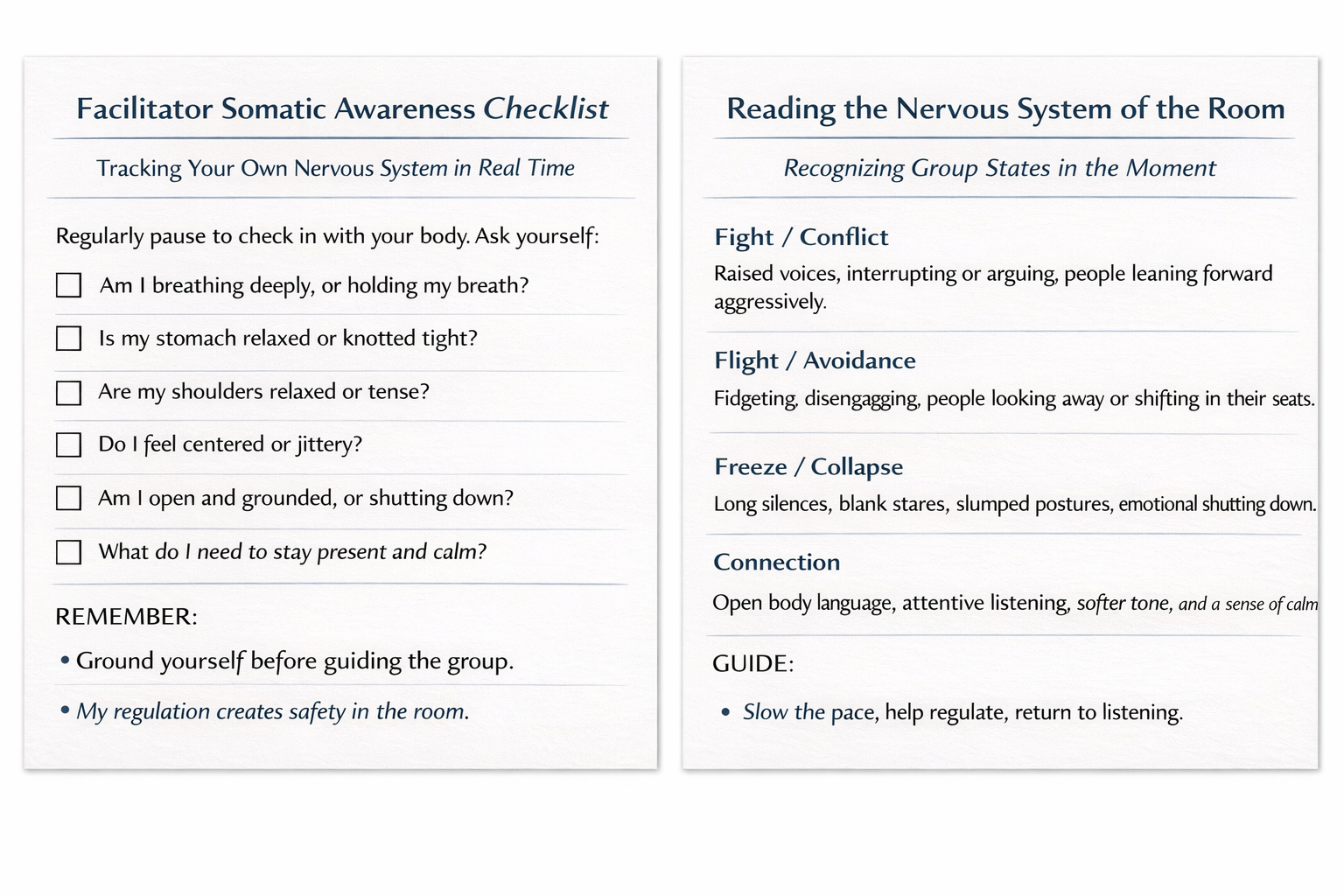
Facilitator Somatic Awareness Checklist
Tracking Your Own Nervous System in Real Time
Before a facilitator can guide others through emotional or relational terrain, they must first remain aware of their own internal state. The body of the facilitator is part of the relational field. When a facilitator becomes dysregulated, overly activated, or emotionally collapsed, the group often mirrors that shift. For this reason, cultivating somatic awareness is not optional—it is an essential leadership skill.
Somatic awareness allows facilitators to notice subtle signals from their own nervous system as they hold space. These signals might include changes in breath, muscle tension, emotional charge, or a sudden impulse to fix, defend, withdraw, or control the room. Rather than suppressing these sensations, skilled facilitators learn to recognize them as information. These bodily cues can signal that the group process is touching something meaningful, sensitive, or unresolved.
Facilitators are encouraged to check in with themselves throughout every session. Over time, facilitators develop the ability to track both the room and themselves simultaneously. This capacity strengthens the relational container and models embodied regulation for participants.
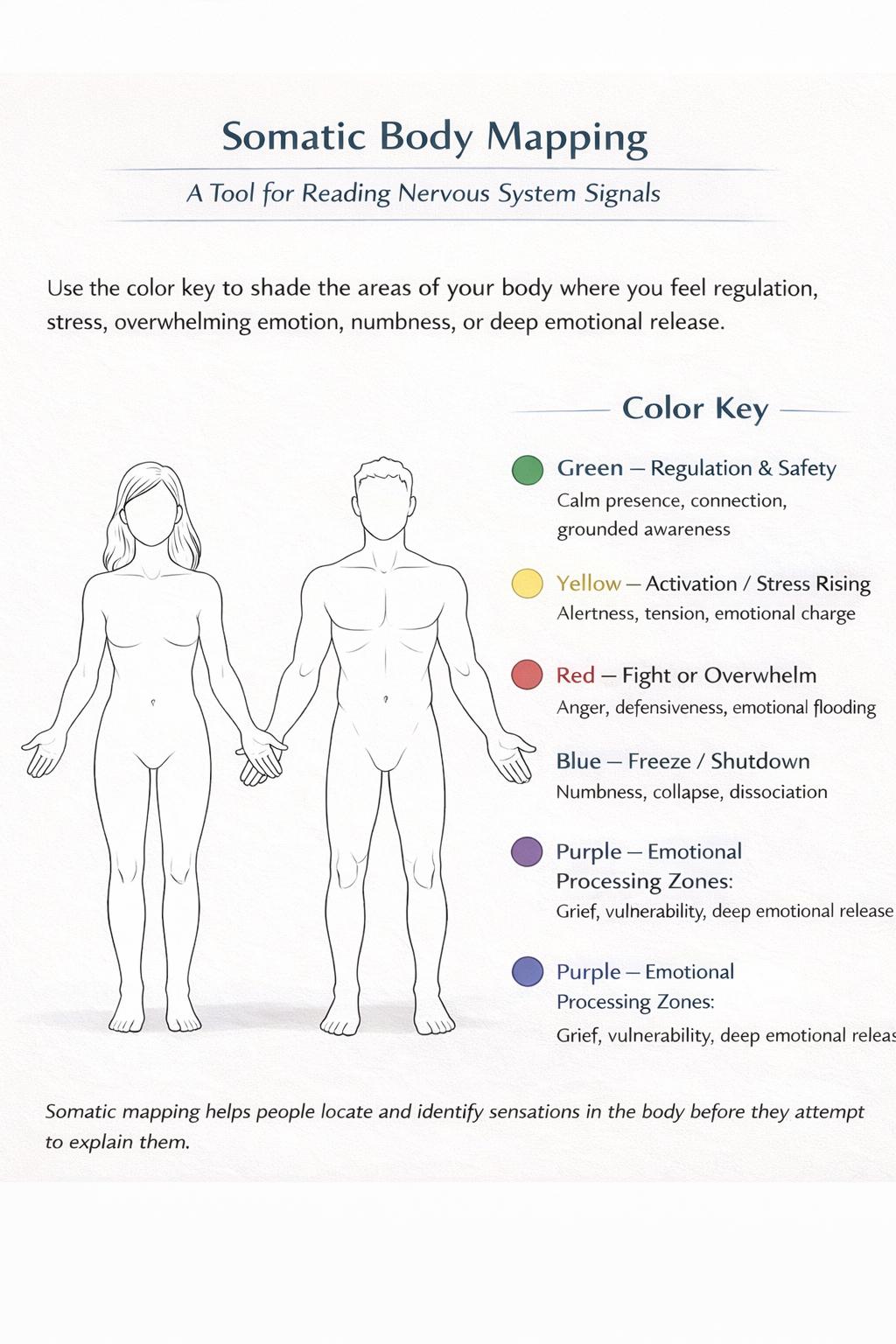
Instructions
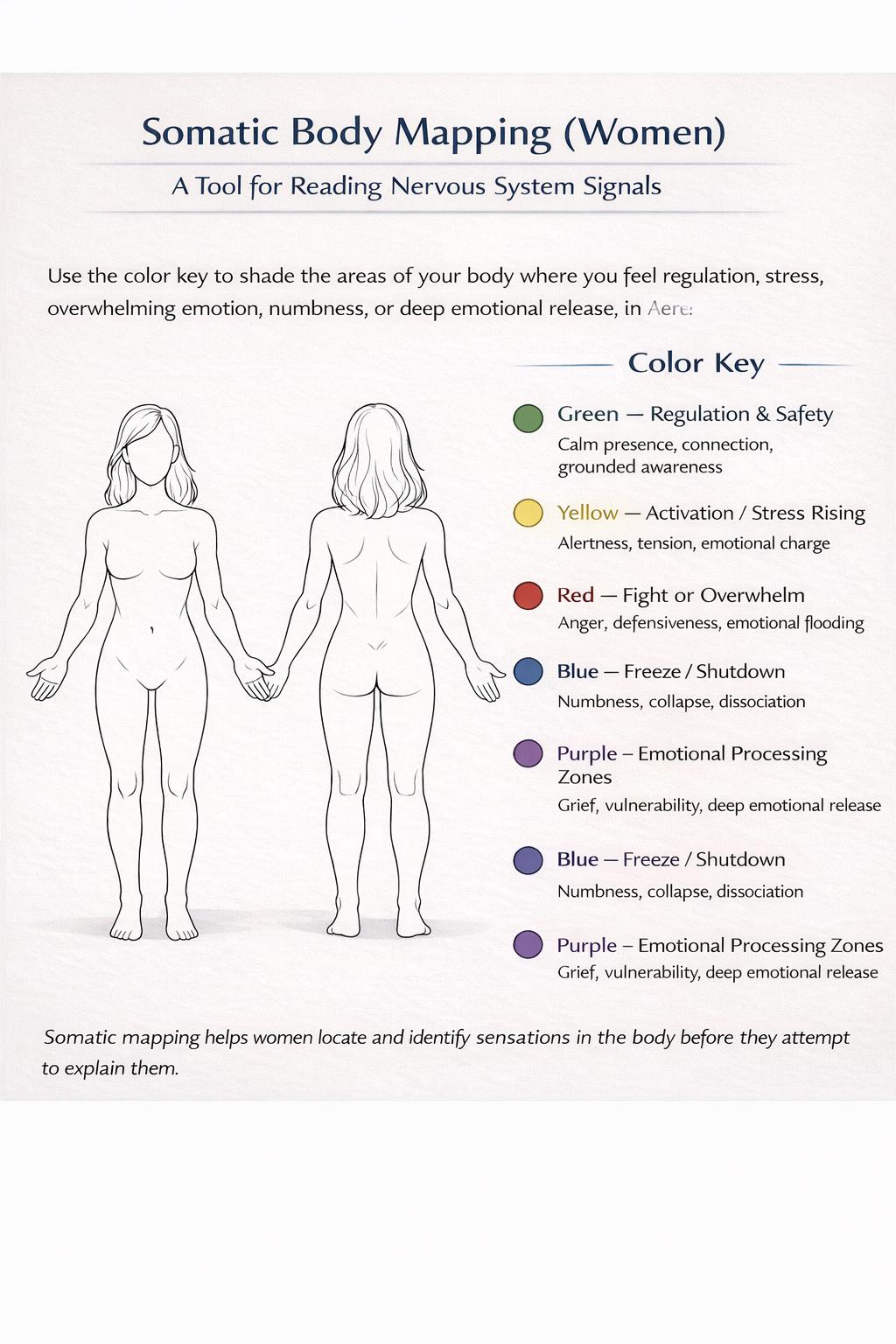
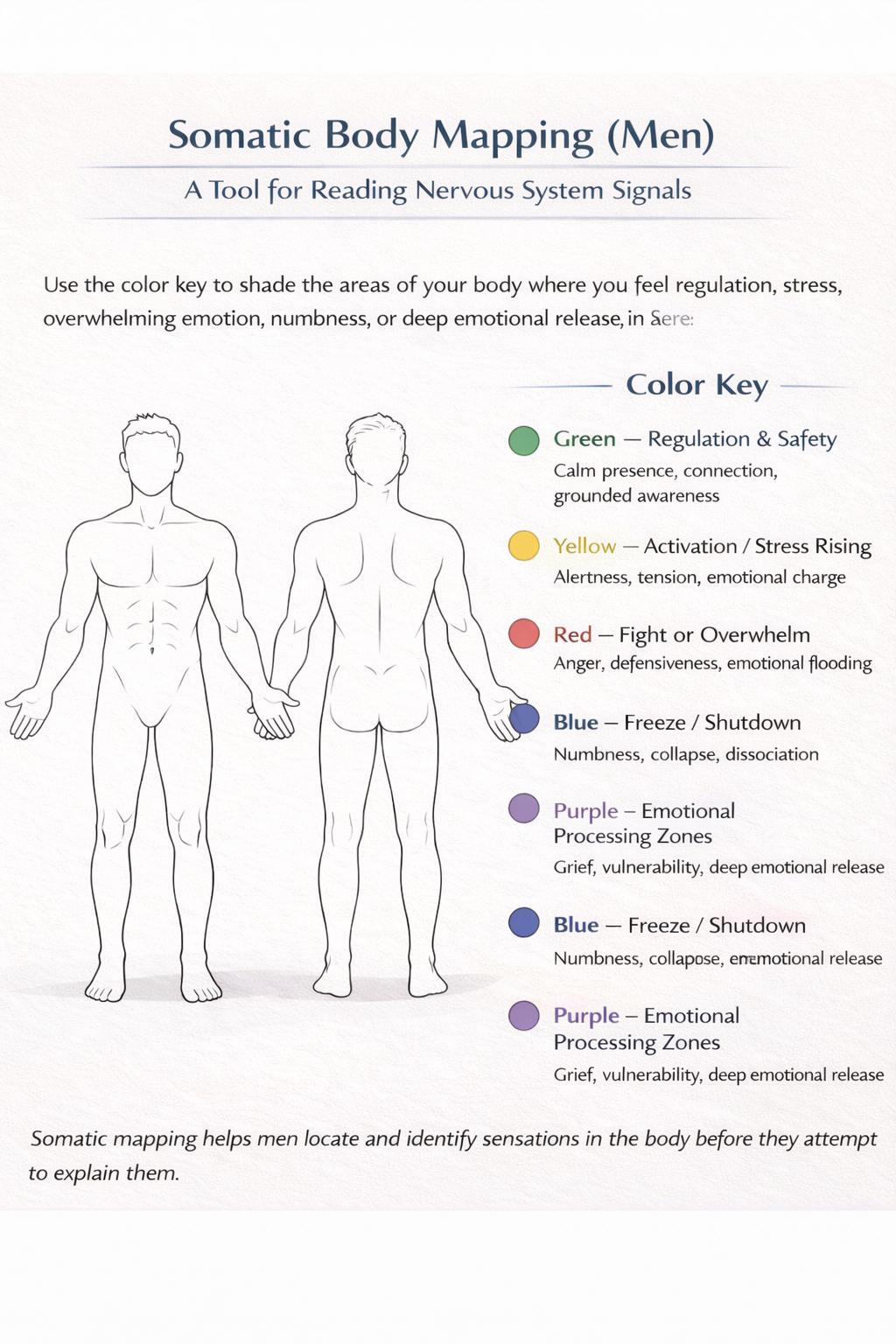
- Look at the front and back body map provided.
- Reflect on where you commonly experience different sensations in your body.
- Use the color key to mark areas where you notice particular emotions or physical sensations.
- You may notice multiple colors in the same area. This is normal.
This exercise is about awareness, not judgment. Take the time to do this next exercise for yourself.
Journal Prompts
After completing the body map, take time to reflect. Please be thorough with your responses. We suggest trying to express at minimum 100 words per prompt. Your answers will be emailed to you for your own records.